Advertisements
Advertisements
प्रश्न
Form a differential equation representing the given family of curves by eliminating arbitrary constants a and b.
y = a e3x + b e– 2x
Advertisements
उत्तर
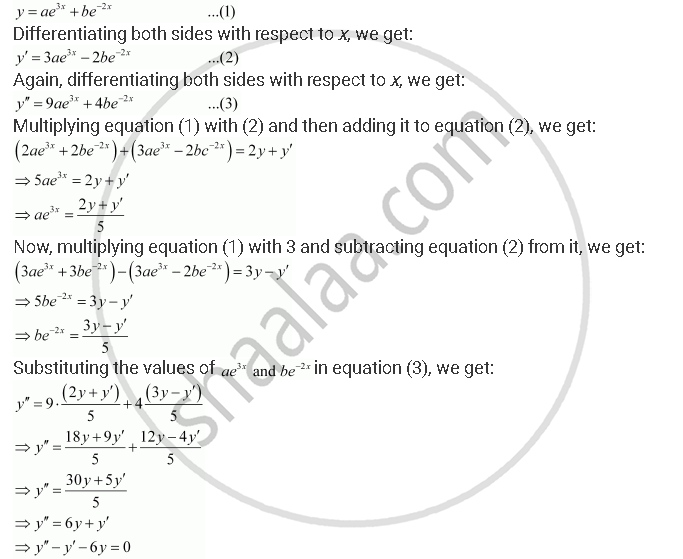
This is the required differential equation of the given curve.
APPEARS IN
संबंधित प्रश्न
Find the differential equation of the family of lines passing through the origin.
Form a differential equation representing the given family of curves by eliminating arbitrary constants a and b.
`x/a + y/b = 1`
Form a differential equation representing the given family of curves by eliminating arbitrary constants a and b.
y2 = a (b2 – x2)
Form a differential equation representing the given family of curves by eliminating arbitrary constants a and b.
y = e2x (a + bx)
Form a differential equation representing the given family of curves by eliminating arbitrary constants a and b.
y = ex (a cos x + b sin x)
Find the particular solution of the differential equation (1 + e2x) dy + (1 + y2) ex dx = 0, given that y = 1 when x = 0.
Solve the differential equation `ye^(x/y) dx = (xe^(x/y) + y^2)dy, (y != 0)`
The general solution of the differential equation ex dy + (y ex + 2x) dx = 0 is ______.
Find the differential equation representing the family of curves `y = ae^(bx + 5)`. where a and b are arbitrary constants.
Form the differential equation having \[y = \left( \sin^{- 1} x \right)^2 + A \cos^{- 1} x + B\], where A and B are arbitrary constants, as its general solution.
The equation of the curve satisfying the differential equation y (x + y3) dx = x (y3 − x) dy and passing through the point (1, 1) is
Show that y2 − x2 − xy = a is a solution of the differential equation \[\left( x - 2y \right)\frac{dy}{dx} + 2x + y = 0.\]
Verify that y = A cos x + sin x satisfies the differential equation \[\cos x\frac{dy}{dx} + \left( \sin x \right)y=1.\]
From x2 + y2 + 2ax + 2by + c = 0, derive a differential equation not containing a, b and c.
\[\frac{dy}{dx} = y^2 + 2y + 2\]
\[\frac{dy}{dx} = x^2 e^x\]
\[\frac{dy}{dx} - x \sin^2 x = \frac{1}{x \log x}\]
\[(\tan^2 x + 2\tan x + 5)\frac{dy}{dx} = 2(1+\tan x)\sec^2x\]
(1 + x) y dx + (1 + y) x dy = 0
cos y log (sec x + tan x) dx = cos x log (sec y + tan y) dy
Solve the differential equation:
cosec3 x dy − cosec y dx = 0
Find the general solution of the following differential equation:
`x (dy)/(dx) = y - xsin(y/x)`
If n is any integer, then the general solution of the equation `cos x - sin x = 1/sqrt(2)` is
General solution of tan 5θ = cot 2θ is
Solution of the equation 3 tan(θ – 15) = tan(θ + 15) is
Which of the following equations has `y = c_1e^x + c_2e^-x` as the general solution?
The general solution of the differential equation `(ydx - xdy)/y` = 0
Find the general solution of differential equation `(dy)/(dx) = (1 - cosx)/(1 + cosx)`
Solve the differential equation: y dx + (x – y2)dy = 0
The general solution of the differential equation ydx – xdy = 0; (Given x, y > 0), is of the form
(Where 'c' is an arbitrary positive constant of integration)
