Advertisements
Advertisements
Question
Advertisements
Solution
Red
RELATED QUESTIONS
A student traces the path of a ray of light through a rectangular glass slab for the different values of angle of incidence. He observes all possible precautions at each step of the experiment. At the end of the experiment, on analyzing the measurements, which of the following conclusions is he likely to draw?
(A) ∠i = ∠e < ∠r
(B) ∠i < ∠e < ∠r
(C) ∠i > ∠e > ∠r
(D) ∠i = ∠e > ∠r
Write a relationship between the angle of incidence and angle of refractions for a given pair of media.
A ray of light passes from glass into air. The angle of refraction will be:
(a) equal to the angle of incidence
(b) greater than the angle of incidence
(c) smaller than the angle of incidence
(d) 45°
The critical angle for glass-air is 45° for the light of yellow colour. State whether it will be less than, equal to, or more than 45° for (i) ref light, (ii) blue light?
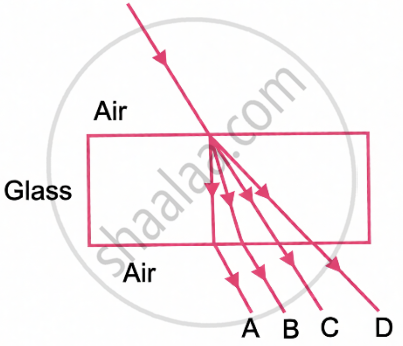
In the fig. name the ray which represents the correct path of light while passing through a glass block.
During sunset and sunrise, the sun is seen when it is slightly below the horizon. Give reason.
Write a relation between the angle of incidence (i), angle of emergence (e), angle of the prism (A), and angle of deviation (d) for a ray of light passing through an equilateral prism.
How is the refractive index of a medium related to its real depth and apparent depth?
How does the angle of deviation produced by a prism depend on the angle of incidence of light at the prism surface? Draw a graph to illustrate your answer.
