Advertisements
Advertisements
Question
Find the volume of a book of length 25 cm, breadth 18 cm and height 2 cm in m3.
Advertisements
Solution
Length of book = l = 25 cm
Breadth of book = b = 18 cm
Height of book = h = 2 cm
Volume of book = l × b × h
V = 25 × 18 × 2
V = 900 cm3
V = `900/10^6"m"^3`
V = `9/10000"m"^3`
V = 0.0009 m3
APPEARS IN
RELATED QUESTIONS
A vernier callipers has a zero error of + 0.06 cm. Draw a neat labelled diagram to represent it.
Draw a neat and labelled diagram of a screw gauge.
Name its main parts and state their functions.
What do you mean by zero error of a screw gauge? How is it accounted for?
The diameter of a thin wire can be measured by
Figure shows the position of vernier scale while measuring the external length of a wooden cylinder.
- What is the length recorded by the main scale?
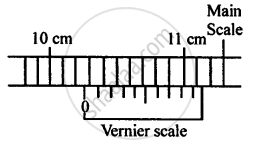
- Which reading of vernier scale coincides with the main scale?
- Calculate the length.
(a) A vernier scale has 20 divisions. It slides over the main scale, whose pitch is 0.5 mm. If the number of divisions on the left hand of the zero of vernier on the main scale is 38 and the 18th vernier scale division coincides with the main scale, calculate the diameter of the sphere, held in the jaws of vernier callipers.
(b) If the vernier has a negative error of 0.04 cm, calculate the corrected radius of the sphere.
What is the need for measuring length with vernier callipers?
The thimble of a screw gauge has 50 divisions for one rotation. The spindle advances 1 mm when the screw is turned through two rotations.
- What is the pitch of the screw?
- What is the least count of screw gauge?
- When the screw gauge is used to measure the diameter of wire the reading on the sleeve is found to be 0.5 mm and reading on thimble is found, 27 divisions. What is the diameter of the wire in centimetres?
