Advertisements
Advertisements
Question
Find the missing values.
| Height 'h' | Parallel side 'a` | Parallel side 'b` | Area |
| 16 cm | 15 cm | 360 sq.cm |
Advertisements
Solution
Given: The height h = 16 cm
Parallel sides a = 15 cm
Area of the trapezium = 360 sq.cm
`1/2` × h × (a + b) = 360
`1/2` × 16 × (15 + b) = 360
15 + b = `360/8`
15 + b = 45
b = 45 – 15 = 30
b = 30 cm
Tabulating the results we get
| Height 'h' | Parallel side 'a` | Parallel side 'b` | Area |
| 16 cm | 15 cm | 30 cm | 360 sq.cm |
APPEARS IN
RELATED QUESTIONS
Find the area, in square metres, of the trapezium whose bases and altitude is as under:
bases = 28 cm and 3 dm, altitude = 25 cm
Find the area of a trapezium whose parallel sides are of length 16 dm and 22 dm and whose height is 12 dm.
Find the height of a trapezium, the sum of the lengths of whose bases (parallel sides) is 60 cm and whose area is 600 cm2.
Find the sum of the lengths of the bases of a trapezium whose area is 4.2 m2 and whose height is 280 cm.
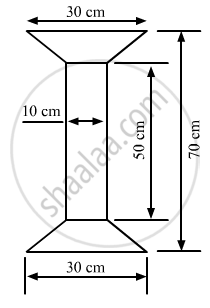
Find the area of Fig. as the sum of the areas of two trapezium and a rectangle.
The cross-section of a canal is a trapezium in shape. If the canal is 10 m wide at the top 6 m wide at the bottom and the area of cross-section is 72 m2 determine its depth.
The area of a trapezium is 1080 sq.cm. If the lengths of its parallel sides are 55.6 cm and 34.4 cm. Find the distance between them
The area of a trapezium is 180 sq.cm and its height is 9 cm. If one of the parallel sides is longer than the other by 6 cm. Find the length of the parallel sides.
The sunshade of a window is in the form of isosceles trapezium whose parallel sides are 81 cm and 64 cm and the distance between them is 6 cm. Find the cost of painting the surface at the rate of ₹ 2 per sq.cm
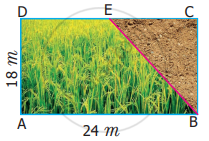
Arivu has a land ABCD with the measurements given in the figure. If a portion ABED is used for cultivation (where E is the mid-point of DC), find the cultivated area.