Advertisements
Advertisements
Question
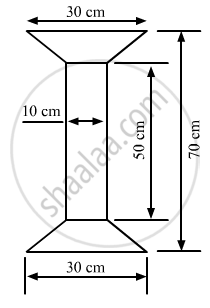
Find the area of Fig. as the sum of the areas of two trapezium and a rectangle.
Advertisements
Solution
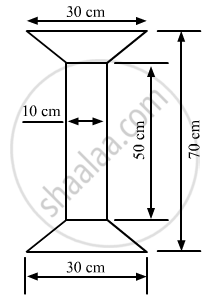
In the given figure, we have a rectangle of length 50 cm and width 10 cm, and two similar trapeziums with parallel sides as 30 cm and 10 cm at both ends.
Suppose x is the perpendicular distance between the parallel sides in both the trapeziums.
We have:
Total length of the given figure = Length of the rectangle + 2 x Perpendicular distancebetween the parallel sides in both the trapeziums
\[70 = 50 + 2 \times x\]
\[2\times x=70-50=20\]
\[x=\frac{20}{2}=10 cm\]
Now, area of the complete figure = (area of the rectangle with sides 50 cm and 10 cm) + 2 x (area of the trapezium with parallel sides 30 cm and 10 cm, and height 10 cm
\[=(50\times10)+2\times[\frac{1}{2}\times(30+10)\times(10)]\]
\[ = 500 + 2 \times [200]\]
= 900 cm2
RELATED QUESTIONS
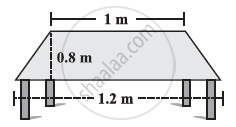
The shape of the top surface of a table is a trapezium. Find its area if its parallel sides are 1 m and 1.2 m and perpendicular distance between them is 0.8 m.
Find the area of a trapezium whose parallel sides are of length 16 dm and 22 dm and whose height is 12 dm.
The area of a trapezium is 1586 cm2 and the distance between the parallel sides is 26 cm. If one of the parallel sides is 38 cm, find the other.
Find the area of a trapezium whose parallel sides are 25 cm, 13 cm and the other sides are 15 cm each.
The following figure shows the cross-section ABCD of a swimming pool which is a trapezium in shape.
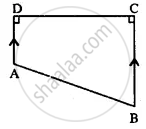
If the width DC, of the swimming pool, is 6.4 m, depth (AD) at the shallow end is 80 cm and depth (BC) at the deepest end is 2.4 m, find its area of the cross-section.
Find the area of a trapezium whose parallel sides are 24 cm and 20 cm and the distance between them is 15 cm
The area of a trapezium is 1080 sq.cm. If the lengths of its parallel sides are 55.6 cm and 34.4 cm. Find the distance between them
The area of a trapezium is 180 sq.cm and its height is 9 cm. If one of the parallel sides is longer than the other by 6 cm. Find the length of the parallel sides.
The area of a trapezium with equal non-parallel sides is 168 m2. If the lengths of the parallel sides are 36 m and 20 m, find the length of the non-parallel sides.
Find the area of the following fields. All dimensions are in metres.

