Advertisements
Advertisements
Question
☐ PQRS is an isosceles trapezium l(PQ) = 7 cm. seg PM ⊥ seg SR, l(SM) = 3 cm, Distance between two parallel sides is 4 cm, find the area of ☐ PQRS.

Advertisements
Solution
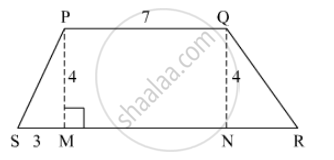
Draw a perpendicular from Q to line MR. Where it meets the line MR, name it point N.
MN = PQ = 7 cm
In ΔPMS,
PM² + SM² = PS²
⇒ 4² + 3² = PS²
⇒ PS² = 16 + 9
⇒ PS² = 25
⇒ PS = 5cm
PQRS is an isosceles trapezium so, PS = QR = 5 cm
PM = QN = 4 cm
So, NR = SM = 3 cm
SR = SM + MN + NR
= 3 + 7 + 3
= 13 cm
Area of trapezium PQRS = `1/2 xx` (sum of parallel sides) × height
=`1/2 xx (7 + 13) xx 4`
= 40 cm²
RELATED QUESTIONS
Find the area, in square metres, of the trapezium whose bases and altitude is as under:
bases = 12 dm and 20 dm, altitude = 10 dm
Find the area, in square metres, of the trapezium whose bases and altitude is as under:
bases = 8 m and 60 dm, altitude = 40 dm
The parallel sides of a trapezium are in ratio 3: 4. If the distance between the parallel sides is 9 dm and its area is 126 dm2; find the lengths of its parallel sides.
The two parallel sides and the distance between them are in the ratio 3: 4: 2. If the area of the trapezium is 175 cm2, find its height.
The area of a trapezium is 279 sq.cm and the distance between its two parallel sides is 18 cm. If one of its parallel sides is longer than the other side by 5 cm, find the lengths of its parallel sides.
Find the area of the trapezium ABCD in which AB || DC, AB = 18 cm, ∠B = ∠C = 90°, CD = 12 cm and AD = 10 cm.
The table top is in the shape of a trapezium with measurements given in the figure. Find the cost of the glass used to cover the table at the rate of ₹ 6 per 10 sq.cm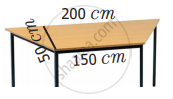
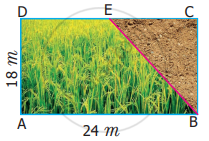
Arivu has a land ABCD with the measurements given in the figure. If a portion ABED is used for cultivation (where E is the mid-point of DC), find the cultivated area.
The area of a trapezium become 4 times if its height gets doubled.
The area of a trapezium with equal non-parallel sides is 168 m2. If the lengths of the parallel sides are 36 m and 20 m, find the length of the non-parallel sides.
