Advertisements
Advertisements
Question
Find distance between point Q(3, –7) and point R(3, 3)
Solution: Suppose Q(x1, y1) and point R(x2, y2)
x1 = 3, y1 = –7 and x2 = 3, y2 = 3
Using distance formula,
d(Q, R) = `sqrt(square)`
∴ d(Q, R) = `sqrt(square - 100)`
∴ d(Q, R) = `sqrt(square)`
∴ d(Q, R) = `square`
Advertisements
Solution
Suppose Q(x1, y1) and point R(x2, y2)
x1 = 3, y1 = –7 and x2 = 3, y2 = 3
Using distance formula,
d(Q, R) = \[\sqrt{\boxed{(x_2 - x_1)^2 + (y_2 - y_1)^2}}\]
= `sqrt((3 - 3)^2 - [3 - (- 7)]^2`
= `sqrt(0^2 + (10)^2)`
∴ d(Q, R) = \[\sqrt{\boxed{0} - 100}\]
∴ d(Q, R) = \[\sqrt{\boxed{100}}\]
∴ d(Q, R) = \[\boxed{10}\]
APPEARS IN
RELATED QUESTIONS
The x-coordinate of a point P is twice its y-coordinate. If P is equidistant from Q(2, –5) and R(–3, 6), find the coordinates of P.
Find the distance between two points
(i) P(–6, 7) and Q(–1, –5)
(ii) R(a + b, a – b) and S(a – b, –a – b)
(iii) `A(at_1^2,2at_1)" and " B(at_2^2,2at_2)`
If two vertices of an equilateral triangle be (0, 0), (3, `sqrt3`), find the third vertex using distance formula.
Prove that the points (–3, 0), (1, –3) and (4, 1) are the vertices of an isosceles right angled triangle. Find the area of this triangle
Find the distance between the following pairs of points:
(−5, 7), (−1, 3)
Find a relation between x and y such that the point (x, y) is equidistant from the point (3, 6) and (–3, 4).
If the point A(x, 2) is equidistant from the points B(8, –2) and C(2, –2), find the value of x. Also, find the length of AB.
Find the distance of the following point from the origin :
(13 , 0)
Find the distance between the following point :
(Sin θ - cosec θ , cos θ - cot θ) and (cos θ - cosec θ , -sin θ - cot θ)
Find the point on y-axis whose distances from the points A (6, 7) and B (4, -3) are in the ratio 1: 2.
Find the distance of the following points from origin.
(a+b, a-b)
By using the distance formula prove that each of the following sets of points are the vertices of a right angled triangle.
(i) (6, 2), (3, -1) and (- 2, 4)
(ii) (-2, 2), (8, -2) and (-4, -3).
The distance between points P(–1, 1) and Q(5, –7) is ______.
Show that the points (2, 0), (–2, 0) and (0, 2) are vertices of a triangle. State the type of triangle with reason.
The distance between the points A(0, 6) and B(0, -2) is ______.
Name the type of triangle formed by the points A(–5, 6), B(–4, –2) and C(7, 5).
If (– 4, 3) and (4, 3) are two vertices of an equilateral triangle, find the coordinates of the third vertex, given that the origin lies in the interior of the triangle.
Read the following passage:
|
Use of mobile screen for long hours makes your eye sight weak and give you headaches. Children who are addicted to play "PUBG" can get easily stressed out. To raise social awareness about ill effects of playing PUBG, a school decided to start 'BAN PUBG' campaign, in which students are asked to prepare campaign board in the shape of a rectangle: One such campaign board made by class X student of the school is shown in the figure.
|
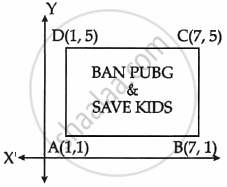
Based on the above information, answer the following questions:
- Find the coordinates of the point of intersection of diagonals AC and BD.
- Find the length of the diagonal AC.
-
- Find the area of the campaign Board ABCD.
OR - Find the ratio of the length of side AB to the length of the diagonal AC.
- Find the area of the campaign Board ABCD.
The distance of the point (5, 0) from the origin is ______.
