Advertisements
Advertisements
Question
Find the diagonal of a rectangle whose length is 16 cm and area is 192 sq.cm ?
Advertisements
Solution
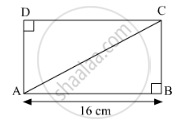
It is given that, area of rectangle is 192 sq.cm.
\[\text{Area} = \text{Length} \times \text{Breadth}\]
\[ \Rightarrow 192 = 16 \times \text{BC}\]
\[ \Rightarrow \text{BC} = \frac{192}{16}\]
\[ \Rightarrow \text{BC} = 12 \text{cm} . . . \left( 1 \right)\]
According to Pythagoras theorem,
In ∆ABC
\[{\text{AB}}^2 + {\text{BC}}^2 = {\text{AC}}^2 \]
\[ \Rightarrow \left( 16 \right)^2 + \left( 12 \right)^2 = {\text{AC}}^2 \]
\[ \Rightarrow 256 + 144 = {\text{AC}}^2 \]
\[ \Rightarrow {\text{AC}}^2 = 400\]
\[ \Rightarrow \text{AC} = 20 \text{cm}\]
Hence, the length of a diagonal of the rectangle is 20 cm.
APPEARS IN
RELATED QUESTIONS
Construct a triangle ABC with sides BC = 7 cm, ∠B = 45° and ∠A = 105°. Then construct a triangle whose sides are `3/4` times the corresponding sides of ∆ABC.
If the sides of a triangle are 3 cm, 4 cm, and 6 cm long, determine whether the triangle is a right-angled triangle.
The sides of triangle is given below. Determine it is right triangle or not.
a = 7 cm, b = 24 cm and c = 25 cm
The sides of triangle is given below. Determine it is right triangle or not.
a = 9 cm, b = l6 cm and c = 18 cm
The sides of triangle is given below. Determine it is right triangle or not.
a = 1.6 cm, b = 3.8 cm and c = 4 cm
The sides of triangle is given below. Determine it is right triangle or not.
a = 8 cm, b = 10 cm and c = 6 cm
A ladder 17 m long reaches a window of a building 15 m above the ground. Find the distance of the foot of the ladder from the building.
The foot of a ladder is 6 m away from a wall and its top reaches a window 8 m above the ground. If the ladder is shifted in such a way that its foot is 8 m away from the wall, to what height does its tip reach?
A triangle has sides 5 cm, 12 cm and 13 cm. Find the length to one decimal place, of the perpendicular from the opposite vertex to the side whose length is 13 cm.
ABCD is a square. F is the mid-point of AB. BE is one third of BC. If the area of ΔFBE = 108 cm2, find the length of AC.
The lengths of the diagonals of a rhombus are 24 cm and 10 cm. Find each side of the rhombus.
Each side of a rhombus is 10 cm. If one of its diagonals is 16 cm find the length of the other diagonal.
In a right ∆ABC right-angled at C, if D is the mid-point of BC, prove that BC2 = 4(AD2 − AC2).
Determine whether the triangle having sides (a – 1) cm, `2sqrta` cm and (a + 1) cm is a right-angled triangle.
Find the length of the altitude of an equilateral triangle of side 2a cm.
Find the length of each side of a rhombus whose diagonals are 24 cm and 10 cm long.
Find the length of each side of a rhombus are 40 cm and 42 cm. Find the length of each side of the rhombus.
From given figure, In ∆ABC, AB ⊥ BC, AB = BC, AC = `2sqrt(2)` then `l` (AB) = ?

