Advertisements
Advertisements
Question
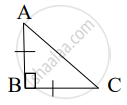
From given figure, In ∆ABC, AB ⊥ BC, AB = BC, AC = `2sqrt(2)` then `l` (AB) = ?

Advertisements
Solution
AB = BC ...[Given]
∴ ∠A = ∠C ...[Isosceles triangle theorem]
Let ∠A = ∠C = x ...(i)
In ∆ABC, ∠A + ∠B + ∠C = 180° ...[Sum of the measures of the angles of a triangle is 180°]
∴ x + 90° + x = 180° ...[From (i)]
∴ 2x = 180° − 90°
∴ 2x = 90°
∴ x = `90^circ/2`
∴ x = 45°
∴ ∠BAC = ∠BCA = 45°
∴ ∆ABC is a 45° – 45° – 90° triangle.
∴ AB = BC = `1/sqrt(2) xx AC` ...[Side opposite to 45°]
= `1/sqrt(2) xx 2sqrt(2)`
∴ `l` (AB) = 2 units
APPEARS IN
RELATED QUESTIONS
Construct a triangle ABC with sides BC = 7 cm, ∠B = 45° and ∠A = 105°. Then construct a triangle whose sides are `3/4` times the corresponding sides of ∆ABC.
If the sides of a triangle are 3 cm, 4 cm, and 6 cm long, determine whether the triangle is a right-angled triangle.
A ladder 17 m long reaches a window of a building 15 m above the ground. Find the distance of the foot of the ladder from the building.
In an isosceles triangle ABC, AB = AC = 25 cm, BC = 14 cm. Calculate the altitude from A on BC.
Two poles of height 9 m and 14 m stand on a plane ground. If the distance between their feet is 12 m, find the distance between their tops.
A triangle has sides 5 cm, 12 cm and 13 cm. Find the length to one decimal place, of the perpendicular from the opposite vertex to the side whose length is 13 cm.
In an isosceles triangle ABC, if AB = AC = 13 cm and the altitude from A on BC is 5 cm, find BC.
In a ΔABC, AB = BC = CA = 2a and AD ⊥ BC. Prove that
(i) AD = a`sqrt3`
(ii) Area (ΔABC) = `sqrt3` a2
Each side of a rhombus is 10 cm. If one of its diagonals is 16 cm find the length of the other diagonal.
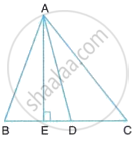
In the following figure, D is the mid-point of side BC and AE ⊥ BC. If BC = a, AC = b, AB = c, ED = x, AD = p and AE = h, prove that:
(i) `b^2 = p^2 + ax + a^2/4`
(ii) `c^2 = p^2 - ax + a^2/4`
(iii) `b^2 + c^2 = 2p^2 + a^2/2`
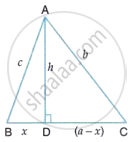
In the given figure, ∠B < 90° and segment AD ⊥ BC, show that
(i) b2 = h2 + a2 + x2 – 2ax
(ii) b2 = a2 + c2 – 2ax
In ∆ABC, ∠A is obtuse, PB ⊥ AC and QC ⊥ AB. Prove that:
(i) AB ✕ AQ = AC ✕ AP
(ii) BC2 = (AC ✕ CP + AB ✕ BQ)
An aeroplane leaves an airport and flies due north at a speed of 1000km/hr. At the same time, another aeroplane leaves the same airport and flies due west at a speed of 1200 km/hr. How far apart will be the two planes after 1 hours?
ΔABC ~ ΔDEF such that ar(ΔABC) = 64 cm2 and ar(ΔDEF) = 169 cm2. If BC = 4 cm, find EF.
A man goes 12 m due south and then 35 m due west. How far is he from the starting point?
The co-ordinates of the points A, B and C are (6, 3), (−3, 5) and (4, −2) respectively. P(x, y) is any point in the plane. Show that \[\frac{ar\left( ∆ PBC \right)}{ar\left( ∆ ABC \right)} = \left| \frac{x + y - 2}{7} \right|\]
Find the diagonal of a rectangle whose length is 16 cm and area is 192 sq.cm ?
From given figure, In ∆ABC, AB ⊥ BC, AB = BC, AC = `5sqrt(2)`, then what is the height of ∆ABC?