Advertisements
Advertisements
प्रश्न
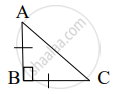
From given figure, In ∆ABC, AB ⊥ BC, AB = BC, AC = `2sqrt(2)` then `l` (AB) = ?

Advertisements
उत्तर
AB = BC ...[Given]
∴ ∠A = ∠C ...[Isosceles triangle theorem]
Let ∠A = ∠C = x ...(i)
In ∆ABC, ∠A + ∠B + ∠C = 180° ...[Sum of the measures of the angles of a triangle is 180°]
∴ x + 90° + x = 180° ...[From (i)]
∴ 2x = 180° − 90°
∴ 2x = 90°
∴ x = `90^circ/2`
∴ x = 45°
∴ ∠BAC = ∠BCA = 45°
∴ ∆ABC is a 45° – 45° – 90° triangle.
∴ AB = BC = `1/sqrt(2) xx AC` ...[Side opposite to 45°]
= `1/sqrt(2) xx 2sqrt(2)`
∴ `l` (AB) = 2 units
APPEARS IN
संबंधित प्रश्न
Construct a triangle ABC with sides BC = 7 cm, ∠B = 45° and ∠A = 105°. Then construct a triangle whose sides are `3/4` times the corresponding sides of ∆ABC.
If the sides of a triangle are 3 cm, 4 cm, and 6 cm long, determine whether the triangle is a right-angled triangle.
The sides of triangle is given below. Determine it is right triangle or not.
a = 7 cm, b = 24 cm and c = 25 cm
A ladder 17 m long reaches a window of a building 15 m above the ground. Find the distance of the foot of the ladder from the building.
Two poles of height 9 m and 14 m stand on a plane ground. If the distance between their feet is 12 m, find the distance between their tops.
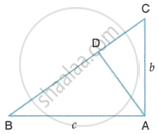
Using Pythagoras theorem determine the length of AD in terms of b and c shown in figure.
A triangle has sides 5 cm, 12 cm and 13 cm. Find the length to one decimal place, of the perpendicular from the opposite vertex to the side whose length is 13 cm.
ABCD is a square. F is the mid-point of AB. BE is one third of BC. If the area of ΔFBE = 108 cm2, find the length of AC.
Calculate the height of an equilateral triangle each of whose sides measures 12 cm.
In a right ∆ABC right-angled at C, if D is the mid-point of BC, prove that BC2 = 4(AD2 − AC2).
In a quadrilateral ABCD, ∠B = 90°, AD2 = AB2 + BC2 + CD2, prove that ∠ACD = 90°.
∆ABD is a right triangle right-angled at A and AC ⊥ BD. Show that
(i) AB2 = BC × BD
(ii) AC2 = BC × DC
(iii) AD2 = BD × CD
(iv) `(AB^2)/(AC^2) = (BD)/(DC)`
Find the length of the altitude of an equilateral triangle of side 2a cm.
Find the diagonal of a rectangle whose length is 16 cm and area is 192 sq.cm ?
From given figure, In ∆ABC, AB ⊥ BC, AB = BC then m∠A = ?
A girl walks 200m towards East and then 150m towards North. The distance of the girl from the starting point is ______.
Find the altitude of an equilateral triangle of side 8 cm.
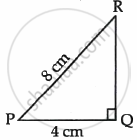
In the given figure, ΔPQR is a right triangle right angled at Q. If PQ = 4 cm and PR = 8 cm, then P is ______.