Advertisements
Advertisements
प्रश्न
Find the diagonal of a rectangle whose length is 16 cm and area is 192 sq.cm ?
Advertisements
उत्तर
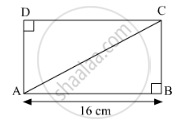
It is given that, area of rectangle is 192 sq.cm.
\[\text{Area} = \text{Length} \times \text{Breadth}\]
\[ \Rightarrow 192 = 16 \times \text{BC}\]
\[ \Rightarrow \text{BC} = \frac{192}{16}\]
\[ \Rightarrow \text{BC} = 12 \text{cm} . . . \left( 1 \right)\]
According to Pythagoras theorem,
In ∆ABC
\[{\text{AB}}^2 + {\text{BC}}^2 = {\text{AC}}^2 \]
\[ \Rightarrow \left( 16 \right)^2 + \left( 12 \right)^2 = {\text{AC}}^2 \]
\[ \Rightarrow 256 + 144 = {\text{AC}}^2 \]
\[ \Rightarrow {\text{AC}}^2 = 400\]
\[ \Rightarrow \text{AC} = 20 \text{cm}\]
Hence, the length of a diagonal of the rectangle is 20 cm.
APPEARS IN
संबंधित प्रश्न
If the sides of a triangle are 3 cm, 4 cm, and 6 cm long, determine whether the triangle is a right-angled triangle.
The sides of triangle is given below. Determine it is right triangle or not.
a = 1.6 cm, b = 3.8 cm and c = 4 cm
The sides of triangle is given below. Determine it is right triangle or not.
a = 8 cm, b = 10 cm and c = 6 cm
Two poles of height 9 m and 14 m stand on a plane ground. If the distance between their feet is 12 m, find the distance between their tops.
A triangle has sides 5 cm, 12 cm and 13 cm. Find the length to one decimal place, of the perpendicular from the opposite vertex to the side whose length is 13 cm.
ABCD is a square. F is the mid-point of AB. BE is one third of BC. If the area of ΔFBE = 108 cm2, find the length of AC.
In a ΔABC, AB = BC = CA = 2a and AD ⊥ BC. Prove that
(i) AD = a`sqrt3`
(ii) Area (ΔABC) = `sqrt3` a2
The lengths of the diagonals of a rhombus are 24 cm and 10 cm. Find each side of the rhombus.
Calculate the height of an equilateral triangle each of whose sides measures 12 cm.
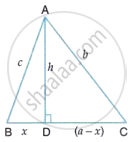
In the given figure, ∠B < 90° and segment AD ⊥ BC, show that
(i) b2 = h2 + a2 + x2 – 2ax
(ii) b2 = a2 + c2 – 2ax
The co-ordinates of the points A, B and C are (6, 3), (−3, 5) and (4, −2) respectively. P(x, y) is any point in the plane. Show that \[\frac{ar\left( ∆ PBC \right)}{ar\left( ∆ ABC \right)} = \left| \frac{x + y - 2}{7} \right|\]
Find the side and perimeter of a square whose diagonal is `13sqrt2` cm.
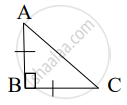
From given figure, In ∆ABC, AB ⊥ BC, AB = BC, AC = `2sqrt(2)` then `l` (AB) = ?

From given figure, In ∆ABC, AB ⊥ BC, AB = BC, AC = `5sqrt(2)`, then what is the height of ∆ABC?
In a ΔABC, ∠CAB is an obtuse angle. P is the circumcentre of ∆ABC. Prove that ∠CAB – ∠PBC = 90°.
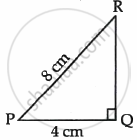
In the given figure, ΔPQR is a right triangle right angled at Q. If PQ = 4 cm and PR = 8 cm, then P is ______.