Advertisements
Advertisements
प्रश्न
Find the diagonal of a rectangle whose length is 16 cm and area is 192 sq.cm ?
Advertisements
उत्तर
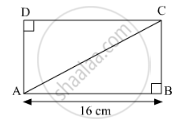
It is given that, area of rectangle is 192 sq.cm.
\[\text{Area} = \text{Length} \times \text{Breadth}\]
\[ \Rightarrow 192 = 16 \times \text{BC}\]
\[ \Rightarrow \text{BC} = \frac{192}{16}\]
\[ \Rightarrow \text{BC} = 12 \text{cm} . . . \left( 1 \right)\]
According to Pythagoras theorem,
In ∆ABC
\[{\text{AB}}^2 + {\text{BC}}^2 = {\text{AC}}^2 \]
\[ \Rightarrow \left( 16 \right)^2 + \left( 12 \right)^2 = {\text{AC}}^2 \]
\[ \Rightarrow 256 + 144 = {\text{AC}}^2 \]
\[ \Rightarrow {\text{AC}}^2 = 400\]
\[ \Rightarrow \text{AC} = 20 \text{cm}\]
Hence, the length of a diagonal of the rectangle is 20 cm.
APPEARS IN
संबंधित प्रश्न
The sides of triangle is given below. Determine it is right triangle or not.
a = 7 cm, b = 24 cm and c = 25 cm
The sides of triangle is given below. Determine it is right triangle or not.
a = 9 cm, b = l6 cm and c = 18 cm
The sides of triangle is given below. Determine it is right triangle or not.
a = 8 cm, b = 10 cm and c = 6 cm
A man goes 15 metres due west and then 8 metres due north. How far is he from the starting point?
Two poles of height 9 m and 14 m stand on a plane ground. If the distance between their feet is 12 m, find the distance between their tops.
In an isosceles triangle ABC, if AB = AC = 13 cm and the altitude from A on BC is 5 cm, find BC.
The lengths of the diagonals of a rhombus are 24 cm and 10 cm. Find each side of the rhombus.
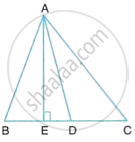
In the following figure, D is the mid-point of side BC and AE ⊥ BC. If BC = a, AC = b, AB = c, ED = x, AD = p and AE = h, prove that:
(i) `b^2 = p^2 + ax + a^2/4`
(ii) `c^2 = p^2 - ax + a^2/4`
(iii) `b^2 + c^2 = 2p^2 + a^2/2`
In ∆ABC, ∠A is obtuse, PB ⊥ AC and QC ⊥ AB. Prove that:
(i) AB ✕ AQ = AC ✕ AP
(ii) BC2 = (AC ✕ CP + AB ✕ BQ)
In a right ∆ABC right-angled at C, if D is the mid-point of BC, prove that BC2 = 4(AD2 − AC2).
In an equilateral ΔABC, AD ⊥ BC, prove that AD2 = 3BD2.
If D, E, F are the respectively the midpoints of sides BC, CA and AB of ΔABC. Find the ratio of the areas of ΔDEF and ΔABC.
Find the length of each side of a rhombus whose diagonals are 24 cm and 10 cm long.
The co-ordinates of the points A, B and C are (6, 3), (−3, 5) and (4, −2) respectively. P(x, y) is any point in the plane. Show that \[\frac{ar\left( ∆ PBC \right)}{ar\left( ∆ ABC \right)} = \left| \frac{x + y - 2}{7} \right|\]
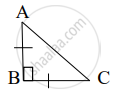
From given figure, In ∆ABC, AB ⊥ BC, AB = BC then m∠A = ?
Find the height of an equilateral triangle having side 4 cm?
A girl walks 200m towards East and then 150m towards North. The distance of the girl from the starting point is ______.
