Advertisements
Advertisements
प्रश्न
Find the side and perimeter of a square whose diagonal is `13sqrt2` cm.
Advertisements
उत्तर
As we know diagonal of a square is `"side"sqrt2`
Here, diagnol = `13sqrt2`
By substitution,
`13sqrt2 = "sides"sqrt2`
Side(s) = `(13sqrt2)/sqrt2`
S = 13cm
Side of square is 13cm
Now, perimeter of square:
P = 4×side(s)
P = 4 × 13
P = 52cm
Hence, perimeter is 52cm
APPEARS IN
संबंधित प्रश्न
If the sides of a triangle are 3 cm, 4 cm, and 6 cm long, determine whether the triangle is a right-angled triangle.
The sides of triangle is given below. Determine it is right triangle or not.
a = 9 cm, b = l6 cm and c = 18 cm
The foot of a ladder is 6 m away from a wall and its top reaches a window 8 m above the ground. If the ladder is shifted in such a way that its foot is 8 m away from the wall, to what height does its tip reach?
In a ΔABC, AB = BC = CA = 2a and AD ⊥ BC. Prove that
(i) AD = a`sqrt3`
(ii) Area (ΔABC) = `sqrt3` a2
Each side of a rhombus is 10 cm. If one of its diagonals is 16 cm find the length of the other diagonal.
Calculate the height of an equilateral triangle each of whose sides measures 12 cm.
In right-angled triangle ABC in which ∠C = 90°, if D is the mid-point of BC, prove that AB2 = 4AD2 – 3AC2.
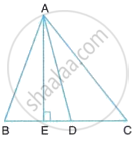
In the following figure, D is the mid-point of side BC and AE ⊥ BC. If BC = a, AC = b, AB = c, ED = x, AD = p and AE = h, prove that:
(i) `b^2 = p^2 + ax + a^2/4`
(ii) `c^2 = p^2 - ax + a^2/4`
(iii) `b^2 + c^2 = 2p^2 + a^2/2`
In an equilateral ΔABC, AD ⊥ BC, prove that AD2 = 3BD2.
∆ABD is a right triangle right-angled at A and AC ⊥ BD. Show that
(i) AB2 = BC × BD
(ii) AC2 = BC × DC
(iii) AD2 = BD × CD
(iv) `(AB^2)/(AC^2) = (BD)/(DC)`
An aeroplane leaves an airport and flies due north at a speed of 1000km/hr. At the same time, another aeroplane leaves the same airport and flies due west at a speed of 1200 km/hr. How far apart will be the two planes after 1 hours?
State Pythagoras' theorem.
If D, E, F are the respectively the midpoints of sides BC, CA and AB of ΔABC. Find the ratio of the areas of ΔDEF and ΔABC.
ΔABC ~ ΔDEF such that ar(ΔABC) = 64 cm2 and ar(ΔDEF) = 169 cm2. If BC = 4 cm, find EF.
In an equilateral triangle with side a, prove that area = `sqrt(3)/4 a^2`.
A man goes 12 m due south and then 35 m due west. How far is he from the starting point?
Find the length of each side of a rhombus are 40 cm and 42 cm. Find the length of each side of the rhombus.
Find the altitude of an equilateral triangle of side 8 cm.
