Advertisements
Advertisements
Question
Find the side and perimeter of a square whose diagonal is `13sqrt2` cm.
Advertisements
Solution
As we know diagonal of a square is `"side"sqrt2`
Here, diagnol = `13sqrt2`
By substitution,
`13sqrt2 = "sides"sqrt2`
Side(s) = `(13sqrt2)/sqrt2`
S = 13cm
Side of square is 13cm
Now, perimeter of square:
P = 4×side(s)
P = 4 × 13
P = 52cm
Hence, perimeter is 52cm
APPEARS IN
RELATED QUESTIONS
Construct a triangle ABC with sides BC = 7 cm, ∠B = 45° and ∠A = 105°. Then construct a triangle whose sides are `3/4` times the corresponding sides of ∆ABC.
If the sides of a triangle are 3 cm, 4 cm, and 6 cm long, determine whether the triangle is a right-angled triangle.
The sides of triangle is given below. Determine it is right triangle or not.
a = 7 cm, b = 24 cm and c = 25 cm
The sides of triangle is given below. Determine it is right triangle or not.
a = 1.6 cm, b = 3.8 cm and c = 4 cm
In an isosceles triangle ABC, AB = AC = 25 cm, BC = 14 cm. Calculate the altitude from A on BC.
The foot of a ladder is 6 m away from a wall and its top reaches a window 8 m above the ground. If the ladder is shifted in such a way that its foot is 8 m away from the wall, to what height does its tip reach?
Two poles of height 9 m and 14 m stand on a plane ground. If the distance between their feet is 12 m, find the distance between their tops.
In a ΔABC, AB = BC = CA = 2a and AD ⊥ BC. Prove that
(i) AD = a`sqrt3`
(ii) Area (ΔABC) = `sqrt3` a2
The lengths of the diagonals of a rhombus are 24 cm and 10 cm. Find each side of the rhombus.
Each side of a rhombus is 10 cm. If one of its diagonals is 16 cm find the length of the other diagonal.
In right-angled triangle ABC in which ∠C = 90°, if D is the mid-point of BC, prove that AB2 = 4AD2 – 3AC2.
In a right ∆ABC right-angled at C, if D is the mid-point of BC, prove that BC2 = 4(AD2 − AC2).
An aeroplane leaves an airport and flies due north at a speed of 1000km/hr. At the same time, another aeroplane leaves the same airport and flies due west at a speed of 1200 km/hr. How far apart will be the two planes after 1 hours?
Determine whether the triangle having sides (a – 1) cm, `2sqrta` cm and (a + 1) cm is a right-angled triangle.
State the converse of Pythagoras' theorem.
ΔABC ~ ΔDEF such that ar(ΔABC) = 64 cm2 and ar(ΔDEF) = 169 cm2. If BC = 4 cm, find EF.
The co-ordinates of the points A, B and C are (6, 3), (−3, 5) and (4, −2) respectively. P(x, y) is any point in the plane. Show that \[\frac{ar\left( ∆ PBC \right)}{ar\left( ∆ ABC \right)} = \left| \frac{x + y - 2}{7} \right|\]
From given figure, In ∆ABC, AB ⊥ BC, AB = BC then m∠A = ?
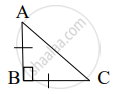
From given figure, In ∆ABC, AB ⊥ BC, AB = BC, AC = `2sqrt(2)` then `l` (AB) = ?

Find the height of an equilateral triangle having side 4 cm?
