Advertisements
Advertisements
Question
In a ΔABC, ∠CAB is an obtuse angle. P is the circumcentre of ∆ABC. Prove that ∠CAB – ∠PBC = 90°.
Advertisements
Solution
Given: ∠CAB is an obtuse angle and P is the circumcentre of ΔABC.
Construction: Draw BD as diameter, join AD.
Proof: ∠CAD = ∠CBD ......[Angles on same arc]
⇒ ∠CAD = ∠CBP ......(i)
Also, ∠BAD = 90° ......(ii) [Angle in semi-circle]
Now, from figure,
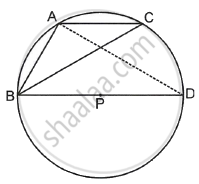
∠CAB = ∠CAD + ∠DAB
⇒ ∠CAB = ∠CBP + 90° ......[Using (i) and (ii)]
⇒ ∠CAB – ∠CBP = 90°
or ∠CAB – ∠PBC = 90°.
Hence proved.
APPEARS IN
RELATED QUESTIONS
Construct a triangle ABC with sides BC = 7 cm, ∠B = 45° and ∠A = 105°. Then construct a triangle whose sides are `3/4` times the corresponding sides of ∆ABC.
The sides of triangle is given below. Determine it is right triangle or not.
a = 7 cm, b = 24 cm and c = 25 cm
The sides of triangle is given below. Determine it is right triangle or not.
a = 9 cm, b = l6 cm and c = 18 cm
The foot of a ladder is 6 m away from a wall and its top reaches a window 8 m above the ground. If the ladder is shifted in such a way that its foot is 8 m away from the wall, to what height does its tip reach?
Using Pythagoras theorem determine the length of AD in terms of b and c shown in figure.
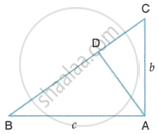
A triangle has sides 5 cm, 12 cm and 13 cm. Find the length to one decimal place, of the perpendicular from the opposite vertex to the side whose length is 13 cm.
ABCD is a square. F is the mid-point of AB. BE is one third of BC. If the area of ΔFBE = 108 cm2, find the length of AC.
The lengths of the diagonals of a rhombus are 24 cm and 10 cm. Find each side of the rhombus.
In an acute-angled triangle, express a median in terms of its sides.
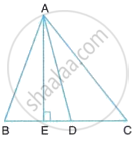
In the following figure, D is the mid-point of side BC and AE ⊥ BC. If BC = a, AC = b, AB = c, ED = x, AD = p and AE = h, prove that:
(i) `b^2 = p^2 + ax + a^2/4`
(ii) `c^2 = p^2 - ax + a^2/4`
(iii) `b^2 + c^2 = 2p^2 + a^2/2`
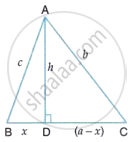
In the given figure, ∠B < 90° and segment AD ⊥ BC, show that
(i) b2 = h2 + a2 + x2 – 2ax
(ii) b2 = a2 + c2 – 2ax
In ∆ABC, ∠A is obtuse, PB ⊥ AC and QC ⊥ AB. Prove that:
(i) AB ✕ AQ = AC ✕ AP
(ii) BC2 = (AC ✕ CP + AB ✕ BQ)
In a quadrilateral ABCD, ∠B = 90°, AD2 = AB2 + BC2 + CD2, prove that ∠ACD = 90°.
An aeroplane leaves an airport and flies due north at a speed of 1000km/hr. At the same time, another aeroplane leaves the same airport and flies due west at a speed of 1200 km/hr. How far apart will be the two planes after 1 hours?
State Pythagoras' theorem.
If D, E, F are the respectively the midpoints of sides BC, CA and AB of ΔABC. Find the ratio of the areas of ΔDEF and ΔABC.
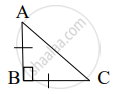
From given figure, In ∆ABC, AB ⊥ BC, AB = BC then m∠A = ?
Find the altitude of an equilateral triangle of side 8 cm.
