Advertisements
Advertisements
Question
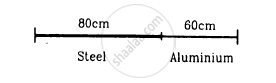
Figure shows an aluminium wire of length 60 cm joined to a steel wire of length 80 cm and stretched between two fixed supports. The tension produced is 40 N. The cross-sectional area of the steel wire is 1⋅0 mm2 and that of the aluminium wire is 3⋅0 mm2. What could be the minimum frequency of a tuning fork which can produce standing waves in the system with the joint as a node? The density of aluminium is 2⋅6 g cm−3 and that of steel is 7⋅8 g cm−3.
Advertisements
Solution
Given:
Length of the aluminium wire (La)= 60 cm = 0.60 m
Length of the steel wire (Ls)= 80 cm = 0.80 m
Tension produced (T) = 40 N
Area of cross-section of the aluminium wire (Aa) = 1.0 mm2
Area of cross-section of the steel wire (As) = 3.0 mm2
Density of aluminium (ρa) = 2⋅6 g cm−3
Density of steel (ρs) = 7⋅8 g cm−3
\[\text{ Mass per unit length of the steel, m_s } = \rho_s \times A_s \]
\[ = 7 . 8 \times {10}^{- 2} gm/cm\]
\[ = 7 . 8 \times {10}^{- 3} kg/m\]
\[\text{ Mass per unit length of the aluminium, m_A }= \rho_A A_A \]
\[ = 2 . 6 \times {10}^{- 2} \times 3 gm/cm\]
\[ = 7 . 8 \times {10}^{- 2} gm/cm\]
\[ = 7 . 8 \times {10}^{- 3} kg/m\]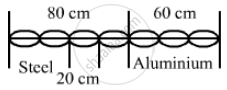
A node is always placed at the joint. Since aluminium and steel rod has same mass per unit length, the velocity of wave (v) in both of them is same.
Let v be the velocity of wave.
\[\Rightarrow v = \left( \frac{T}{m} \right)\]
\[ = \sqrt{\left\{ \frac{40}{7 . 8 \times {10}^{- 3}} \right\}}^- \]
\[ = \sqrt{\left( \frac{4 \times {10}^4}{7 . 8} \right)}\]
\[ \Rightarrow v = 71 . 6 m/s\]
For minimum frequency, there would be maximum wavelength.
For maximum wavelength, minimum number of loops are to be produced.
∴ Maximum distance of a loop = 20 cm
\[\Rightarrow \text{ Wavelength, } \lambda = 2 \times 20 = 40 cm\]
\[\text{ Or } \lambda = 0 . 4 m\]
\[ \therefore Frequency, f = \frac{v}{\lambda} = \frac{71 . 6}{0 . 4} = 180 Hz\]
APPEARS IN
RELATED QUESTIONS
A stone dropped from the top of a tower of height 300 m high splashes into the water of a pond near the base of the tower. When is the splash heard at the top given that the speed of sound in air is 340 m s–1? (g= 9.8 m s–2)
You have learnt that a travelling wave in one dimension is represented by a function y= f (x, t)where x and t must appear in the combination x – v t or x + v t, i.e. y = f (x ± v t). Is the converse true? Examine if the following functions for y can possibly represent a travelling wave:
(a) `(x – vt )^2`
(b) `log [(x + vt)/x_0]`
(c) `1/(x + vt)`
For the wave described in Exercise 15.8, plot the displacement (y) versus (t) graphs for x = 0, 2 and 4 cm. What are the shapes of these graphs? In which aspects does the oscillatory motion in travelling wave differ from one point to another: amplitude, frequency or phase?
(i) For the wave on a string described in Exercise 15.11, do all the points on the string oscillate with the same (a) frequency, (b) phase, (c) amplitude? Explain your answers. (ii) What is the amplitude of a point 0.375 m away from one end?
A metre-long tube open at one end, with a movable piston at the other end, shows resonance with a fixed frequency source (a tuning fork of frequency 340 Hz) when the tube length is 25.5 cm or 79.3 cm. Estimate the speed of sound in air at the temperature of the experiment. The edge effects may be neglected.
A SONAR system fixed in a submarine operates at a frequency 40.0 kHz. An enemy submarine moves towards the SONAR with a speed of 360 km h–1. What is the frequency of sound reflected by the submarine? Take the speed of sound in water to be 1450 m s–1.
Earthquakes generate sound waves inside the earth. Unlike a gas, the earth can experience both transverse (S) and longitudinal (P) sound waves. Typically the speed of S wave is about 4.0 km s–1, and that of P wave is 8.0 km s–1. A seismograph records P and S waves from an earthquake. The first P wave arrives 4 min before the first S wave. Assuming the waves travel in straight line, at what distance does the earthquake occur?
The radio and TV programmes, telecast at the studio, reach our antenna by wave motion. Is it a mechanical wave or nonmechanical?
Show that for a wave travelling on a string
\[\frac{y_{max}}{\nu_{max}} = \frac{\nu_{max}}{\alpha_{max}},\]
where the symbols have usual meanings. Can we use componendo and dividendo taught in algebra to write
\[\frac{y_{max} + \nu_{max}}{\nu_{max} - \nu_{max}} = \frac{\nu_{max} + \alpha_{max}}{\nu_{max} - \alpha_{max}}?\]
A sine wave is travelling in a medium. A particular particle has zero displacement at a certain instant. The particle closest to it having zero displacement is at a distance
Two strings A and B, made of same material, are stretched by same tension. The radius of string A is double of the radius of B. A transverse wave travels on A with speed `v_A` and on B with speed `v_B`. The ratio `v_A/v_B` is ______.
The equation of a wave travelling on a string is:
\[y = \left( 0 \cdot 10 \text{ mm } \right) \sin\left[ \left( 31 \cdot 4 m^{- 1} \right)x + \left( 314 s^{- 1} \right)t \right]\]
- In which direction does the wave travel?
- Find the wave speed, the wavelength and the frequency of the wave.
- What is the maximum displacement and the maximum speed of a portion of the string?
A steel wire fixed at both ends has a fundamental frequency of 200 Hz. A person can hear sound of maximum frequency 14 kHz. What is the highest harmonic that can be played on this string which is audible to the person?
What is the interference of sound waves?
A string 1 m long is fixed at one end. The other end is moved up and down with a frequency of 20 Hz. Due to this, a stationary wave with four complete loops gets produced on the string. Find the speed of the progressive wave which produces the stationary wave.
A transverse harmonic wave on a string is described by y(x, t) = 3.0 sin (36t + 0.018x + π/4) where x and y are in cm and t is in s. The positive direction of x is from left to right.
- The wave is travelling from right to left.
- The speed of the wave is 20 m/s.
- Frequency of the wave is 5.7 Hz.
- The least distance between two successive crests in the wave is 2.5 cm.
Speed of sound waves in a fluid depends upon ______.
- directty on density of the medium.
- square of Bulk modulus of the medium.
- inversly on the square root of density.
- directly on the square root of bulk modulus of the medium.
If c is r.m.s. speed of molecules in a gas and v is the speed of sound waves in the gas, show that c/v is constant and independent of temperature for all diatomic gases.
The displacement y of a particle in a medium can be expressed as, y = `10^-6sin(100t + 20x + pi/4)` m where t is in second and x in meter. The speed of the wave is ______.
