Advertisements
Advertisements
प्रश्न
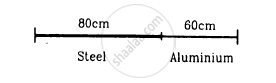
Figure shows an aluminium wire of length 60 cm joined to a steel wire of length 80 cm and stretched between two fixed supports. The tension produced is 40 N. The cross-sectional area of the steel wire is 1⋅0 mm2 and that of the aluminium wire is 3⋅0 mm2. What could be the minimum frequency of a tuning fork which can produce standing waves in the system with the joint as a node? The density of aluminium is 2⋅6 g cm−3 and that of steel is 7⋅8 g cm−3.
Advertisements
उत्तर
Given:
Length of the aluminium wire (La)= 60 cm = 0.60 m
Length of the steel wire (Ls)= 80 cm = 0.80 m
Tension produced (T) = 40 N
Area of cross-section of the aluminium wire (Aa) = 1.0 mm2
Area of cross-section of the steel wire (As) = 3.0 mm2
Density of aluminium (ρa) = 2⋅6 g cm−3
Density of steel (ρs) = 7⋅8 g cm−3
\[\text{ Mass per unit length of the steel, m_s } = \rho_s \times A_s \]
\[ = 7 . 8 \times {10}^{- 2} gm/cm\]
\[ = 7 . 8 \times {10}^{- 3} kg/m\]
\[\text{ Mass per unit length of the aluminium, m_A }= \rho_A A_A \]
\[ = 2 . 6 \times {10}^{- 2} \times 3 gm/cm\]
\[ = 7 . 8 \times {10}^{- 2} gm/cm\]
\[ = 7 . 8 \times {10}^{- 3} kg/m\]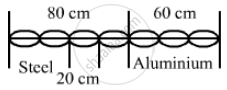
A node is always placed at the joint. Since aluminium and steel rod has same mass per unit length, the velocity of wave (v) in both of them is same.
Let v be the velocity of wave.
\[\Rightarrow v = \left( \frac{T}{m} \right)\]
\[ = \sqrt{\left\{ \frac{40}{7 . 8 \times {10}^{- 3}} \right\}}^- \]
\[ = \sqrt{\left( \frac{4 \times {10}^4}{7 . 8} \right)}\]
\[ \Rightarrow v = 71 . 6 m/s\]
For minimum frequency, there would be maximum wavelength.
For maximum wavelength, minimum number of loops are to be produced.
∴ Maximum distance of a loop = 20 cm
\[\Rightarrow \text{ Wavelength, } \lambda = 2 \times 20 = 40 cm\]
\[\text{ Or } \lambda = 0 . 4 m\]
\[ \therefore Frequency, f = \frac{v}{\lambda} = \frac{71 . 6}{0 . 4} = 180 Hz\]
APPEARS IN
संबंधित प्रश्न
A steel wire has a length of 12.0 m and a mass of 2.10 kg. What should be the tension in the wire so that speed of a transverse wave on the wire equals the speed of sound in dry air at 20 °C = 343 m s–1.
You have learnt that a travelling wave in one dimension is represented by a function y= f (x, t)where x and t must appear in the combination x – v t or x + v t, i.e. y = f (x ± v t). Is the converse true? Examine if the following functions for y can possibly represent a travelling wave:
(a) `(x – vt )^2`
(b) `log [(x + vt)/x_0]`
(c) `1/(x + vt)`
A wire stretched between two rigid supports vibrates in its fundamental mode with a frequency of 45 Hz. The mass of the wire is 3.5 × 10⁻² kg and its linear mass density is 4.0 × 10⁻² kg m–1. What is (a) the speed of a transverse wave on the string, and (b) the tension in the string?
A train, standing at the outer signal of a railway station blows a whistle of frequency 400 Hz in still air. (i) What is the frequency of the whistle for a platform observer when the train (a) approaches the platform with a speed of 10 m s–1, (b) recedes from the platform with a speed of 10 m s–1? (ii) What is the speed of sound in each case? The speed of sound in still air can be taken as 340 m s–1.
Earthquakes generate sound waves inside the earth. Unlike a gas, the earth can experience both transverse (S) and longitudinal (P) sound waves. Typically the speed of S wave is about 4.0 km s–1, and that of P wave is 8.0 km s–1. A seismograph records P and S waves from an earthquake. The first P wave arrives 4 min before the first S wave. Assuming the waves travel in straight line, at what distance does the earthquake occur?
Two strings A and B, made of same material, are stretched by same tension. The radius of string A is double of the radius of B. A transverse wave travels on A with speed `v_A` and on B with speed `v_B`. The ratio `v_A/v_B` is ______.
Two sine waves travel in the same direction in a medium. The amplitude of each wave is A and the phase difference between the two waves is 120°. The resultant amplitude will be
A sonometer wire of length l vibrates in fundamental mode when excited by a tuning fork of frequency 416. Hz. If the length is doubled keeping other things same, the string will ______.
A string of length 40 cm and weighing 10 g is attached to a spring at one end and to a fixed wall at the other end. The spring has a spring constant of 160 N m−1 and is stretched by 1⋅0 cm. If a wave pulse is produced on the string near the wall, how much time will it take to reach the spring?
A string 1 m long is fixed at one end. The other end is moved up and down with a frequency of 20 Hz. Due to this, a stationary wave with four complete loops gets produced on the string. Find the speed of the progressive wave which produces the stationary wave.
Use the formula `v = sqrt((gamma P)/rho)` to explain why the speed of sound in air is independent of pressure.
Use the formula `v = sqrt((gamma P)/rho)` to explain why the speed of sound in air increases with temperature.
Sound waves of wavelength λ travelling in a medium with a speed of v m/s enter into another medium where its speed is 2v m/s. Wavelength of sound waves in the second medium is ______.
Speed of sound waves in a fluid depends upon ______.
- directty on density of the medium.
- square of Bulk modulus of the medium.
- inversly on the square root of density.
- directly on the square root of bulk modulus of the medium.
A wave of frequency υ = 1000 Hz, propagates at a velocity v = 700 m/sec along x-axis. Phase difference at a given point x during a time interval M = 0.5 × 10⁻³ sec is ______.
An engine is approaching a cliff at a constant speed. When it is at a distance of 0.9 km from cliff it sounds a whistle. The echo of the sound is heard by the driver after 5 seconds. Velocity of sound in air is equal to 330 ms-1. The speed of the engine is ______ km/h.
The displacement y of a particle in a medium can be expressed as, y = `10^-6sin(100t + 20x + pi/4)` m where t is in second and x in meter. The speed of the wave is ______.
