Advertisements
Advertisements
प्रश्न
A 40 cm wire having a mass of 3⋅2 g is stretched between two fixed supports 40⋅05 cm apart. In its fundamental mode, the wire vibrates at 220 Hz. If the area of cross section of the wire is 1⋅0 mm2, find its Young modulus.
Advertisements
उत्तर
Given:
Length of the wire (L) = 40 cm = 0.40 m
Mass of the wire = 3.2 g = 0.003 kg
Distance between the two fixed supports of the wire = 40.05 cm
Fundamental mode frequency = 220 Hz
Therefore, linear mass density of the wire (m) is given by:
\[m = \frac{0 . 0032}{0 . 4} = 8 \times {10}^{- 3} kg/m\]
\[\text{ Change in length, } ∆ L = 40 . 05 - 40 = 0 . 05 cm\]
\[= 0 . 05 \times {10}^{- 2} m\]
\[Strain = \frac{∆ L}{L} = \frac{0 . 05 \times {10}^{- 2}}{0 . 4}\]
\[ = 0 . 125 \times {10}^{- 2} \]
\[ f_0 = \frac{1}{2L}\sqrt{\frac{T}{m}}\]
\[ = \frac{1}{2 \times \left( 0 . 4005 \right)} \sqrt{\frac{T}{8 \times {10}^{- 3}}}\]
\[\Rightarrow 220 \times 220 = \left[ \frac{1}{\left( 0 . 801 \right)^2} \right] \times T \times \left( \frac{{10}^3}{8} \right)\]
\[ \Rightarrow T \times 1000 = 220 \times 220 \times 0 . 641 \times 0 . 8\]
\[ \Rightarrow T = 248 . 19 N\]
\[Stress = \frac{Tension}{Area} = \frac{248 . 19}{1 {mm}^2} = \frac{248 . 19}{{10}^{- 6}}\]
\[ \Rightarrow Stress = 248 . 19 \times {10}^6 \]
\[\text{ Young's modulus, } Y = \frac{stress}{strain}\]
\[ = \frac{248 . 19 \times {10}^6}{0 . 125 \times {10}^{- 2}}\]
\[ \Rightarrow Y = 19852 \times {10}^8 \]
\[ = 1 . 985 \times {10}^{11} N/ m^2\]
Hence, the required Young's modulus of the wire is
\[1 . 985 \times {10}^{11} N/ m^2\]
APPEARS IN
संबंधित प्रश्न
Use the formula `v = sqrt((gamma P)/rho)` to explain why the speed of sound in air increases with humidity.
For the wave described in Exercise 15.8, plot the displacement (y) versus (t) graphs for x = 0, 2 and 4 cm. What are the shapes of these graphs? In which aspects does the oscillatory motion in travelling wave differ from one point to another: amplitude, frequency or phase?
A steel rod 100 cm long is clamped at its middle. The fundamental frequency of longitudinal vibrations of the rod is given to be 2.53 kHz. What is the speed of sound in steel?
Two strings A and B, made of same material, are stretched by same tension. The radius of string A is double of the radius of B. A transverse wave travels on A with speed `v_A` and on B with speed `v_B`. The ratio `v_A/v_B` is ______.
A wave pulse, travelling on a two-piece string, gets partially reflected and partially transmitted at the junction. The reflected wave is inverted in shape as compared to the incident one. If the incident wave has wavelength λ and the transmitted wave λ'
Two wave pulses travel in opposite directions on a string and approach each other. The shape of one pulse is inverted with respect to the other.
A sonometer wire of length l vibrates in fundamental mode when excited by a tuning fork of frequency 416. Hz. If the length is doubled keeping other things same, the string will ______.
A wave pulse is travelling on a string with a speed \[\nu\] towards the positive X-axis. The shape of the string at t = 0 is given by g(x) = Asin(x/a), where A and a are constants. (a) What are the dimensions of A and a ? (b) Write the equation of the wave for a general time t, if the wave speed is \[\nu\].
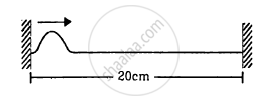
A string of length 20 cm and linear mass density 0⋅40 g cm−1 is fixed at both ends and is kept under a tension of 16 N. A wave pulse is produced at t = 0 near an ends as shown in the figure, which travels towards the other end. (a) When will the string have the shape shown in the figure again? (b) Sketch the shape of the string at a time half of that found in part (a).
A 200 Hz wave with amplitude 1 mm travels on a long string of linear mass density 6 g m−1 kept under a tension of 60 N. (a) Find the average power transmitted across a given point on the string. (b) Find the total energy associated with the wave in a 2⋅0 m long portion of the string.
Two waves, travelling in the same direction through the same region, have equal frequencies, wavelengths and amplitudes. If the amplitude of each wave is 4 mm and the phase difference between the waves is 90°, what is the resultant amplitude?
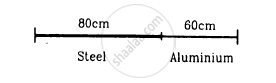
Figure shows an aluminium wire of length 60 cm joined to a steel wire of length 80 cm and stretched between two fixed supports. The tension produced is 40 N. The cross-sectional area of the steel wire is 1⋅0 mm2 and that of the aluminium wire is 3⋅0 mm2. What could be the minimum frequency of a tuning fork which can produce standing waves in the system with the joint as a node? The density of aluminium is 2⋅6 g cm−3 and that of steel is 7⋅8 g cm−3.
An organ pipe of length 0.4 m is open at both ends. The speed of sound in the air is 340 m/s. The fundamental frequency is ______
A bat emits an ultrasonic sound of frequency 1000 kHz in the air. If the sound meets a water surface, what is the wavelength of the the reflected sound? The speed of sound in air is 340 m s–1 and in water 1486 m s–1.
For the travelling harmonic wave
y (x, t) = 2.0 cos 2π (10t – 0.0080x + 0.35)
Where x and y are in cm and t in s. Calculate the phase difference between oscillatory motion of two points separated by a distance of `λ/2`.
A transverse harmonic wave on a string is described by y(x, t) = 3.0 sin (36t + 0.018x + π/4) where x and y are in cm and t is in s. The positive direction of x is from left to right.
- The wave is travelling from right to left.
- The speed of the wave is 20 m/s.
- Frequency of the wave is 5.7 Hz.
- The least distance between two successive crests in the wave is 2.5 cm.
At what temperatures (in °C) will the speed of sound in air be 3 times its value at O°C?
A wave of frequency υ = 1000 Hz, propagates at a velocity v = 700 m/sec along x-axis. Phase difference at a given point x during a time interval M = 0.5 × 10⁻³ sec is ______.
