Advertisements
Advertisements
प्रश्न
A travelling wave is produced on a long horizontal string by vibrating an end up and down sinusoidally. The amplitude of vibration is 1⋅0 and the displacement becomes zero 200 times per second. The linear mass density of the string is 0⋅10 kg m−1 and it is kept under a tension of 90 N. (a) Find the speed and the wavelength of the wave. (b) Assume that the wave moves in the positive x-direction and at t = 0, the end x = 0 is at its positive extreme position. Write the wave equation. (c) Find the velocity and acceleration of the particle at x = 50 cm at time t = 10 ms.
Advertisements
उत्तर
Given,
Amplitude of the wave = 1 cm
Frequency of the wave,
\[f = \frac{200}{2} = 100 \text{ Hz }\]
Mass per unit length, m = 0.1 kg/m
Applied tension, T = 90 N
(a) Velocity of the wave is given by
\[v = \sqrt{\frac{T}{m}}\]
Thus, we have:\[v = \sqrt{\left( \frac{90}{0 . 1} \right)} = 30 m/s\]
Now,
\[\text{ Wavelength, } \lambda = \frac{v}{f} = \frac{30}{100} = 0 . 3 m\]
\[ \Rightarrow \lambda = 30 cm\]
(b) At x = 0, displacement is maximum.
Thus, the wave equation is given by
\[y = \left( 1 cm \right)\cos2\pi\left\{ \left( \frac{t}{0 . 01 s} \right) - \left( \frac{x}{30 cm} \right) \right\}\] ...(1)
(c) Using \[\cos\left( - \theta \right) = \cos\theta\]
in equation (1), we get:
\[y = 1\cos2\pi\left( \frac{x}{30} - \frac{t}{0 . 01} \right)\]
\[Velocity, v = \frac{dy}{dt}\]
\[ \Rightarrow v = \left( \frac{2\pi}{0 . 01} \right)\sin2\pi\left\{ \frac{x}{30} - \frac{t}{0 . 01} \right\}\]
And,
Acceleration, \[a = \frac{d\nu}{dt}\]
\[ \Rightarrow a = \left\{ \frac{4 \pi^2}{\left( 0 . 01 \right)^2} \right\}\cos2\pi\left\{ \left( \frac{x}{30} \right) - \left( \frac{t}{0 . 01} \right) \right\}\]
\[\text{ When x = 50 cm, t = 10 ms = 10 \times {10}^{- 3} s .}\]
Now,
\[v = \left( \frac{2\pi}{0 . 01} \right)\sin2\pi\left\{ \left( \frac{5}{3} \right) - \left( \frac{0 . 01}{0 . 01} \right) \right\}\]
\[ = \left( \frac{2\pi}{0 . 01} \right)\sin\left( 2\pi \times \frac{2}{3} \right)\]
\[= - \left( \frac{2\pi}{0 . 01} \right)\sin\frac{4\pi}{3}\]
\[= - 200\pi\sin\frac{\pi}{3}\]
\[= - 200\pi \times \frac{\sqrt{3}}{2}\]
\[= - 544 cm/s\]
\[= - 5 . 4 m/s\]
In magnitude, v = 5.4 m/s.
Similarly,
\[a = \left\{ \frac{4 \pi^2}{\left( 0 . 01 \right)^2} \right\}\cos2\pi\left\{ \left( \frac{5}{3} \right) - 1 \right\}\]
\[ = 4 \pi^2 \times {10}^4 \times \frac{1}{2}\]
\[ \approx 2 \times {10}^5 cm/ s^2 \text{ or 2 km}/ s^2\]
APPEARS IN
संबंधित प्रश्न
A stone dropped from the top of a tower of height 300 m high splashes into the water of a pond near the base of the tower. When is the splash heard at the top given that the speed of sound in air is 340 m s–1? (g= 9.8 m s–2)
A wire stretched between two rigid supports vibrates in its fundamental mode with a frequency of 45 Hz. The mass of the wire is 3.5 × 10⁻² kg and its linear mass density is 4.0 × 10⁻² kg m–1. What is (a) the speed of a transverse wave on the string, and (b) the tension in the string?
A metre-long tube open at one end, with a movable piston at the other end, shows resonance with a fixed frequency source (a tuning fork of frequency 340 Hz) when the tube length is 25.5 cm or 79.3 cm. Estimate the speed of sound in air at the temperature of the experiment. The edge effects may be neglected.
A train, standing at the outer signal of a railway station blows a whistle of frequency 400 Hz in still air. (i) What is the frequency of the whistle for a platform observer when the train (a) approaches the platform with a speed of 10 m s–1, (b) recedes from the platform with a speed of 10 m s–1? (ii) What is the speed of sound in each case? The speed of sound in still air can be taken as 340 m s–1.
A train, standing in a station-yard, blows a whistle of frequency 400 Hz in still air. The wind starts blowing in the direction from the yard to the station with at a speed of 10 m s–1. What are the frequency, wavelength, and speed of sound for an observer standing on the station’s platform? Is the situation exactly identical to the case when the air is still and the observer runs towards the yard at a speed of 10 m s–1? The speed of sound in still air can be taken as 340 m s–1.
A sine wave is travelling in a medium. A particular particle has zero displacement at a certain instant. The particle closest to it having zero displacement is at a distance
A wave pulse, travelling on a two-piece string, gets partially reflected and partially transmitted at the junction. The reflected wave is inverted in shape as compared to the incident one. If the incident wave has wavelength λ and the transmitted wave λ'
Two waves of equal amplitude A, and equal frequency travel in the same direction in a medium. The amplitude of the resultant wave is
A sonometer wire of length l vibrates in fundamental mode when excited by a tuning fork of frequency 416. Hz. If the length is doubled keeping other things same, the string will ______.
A sonometer wire supports a 4 kg load and vibrates in fundamental mode with a tuning fork of frequency 416. Hz. The length of the wire between the bridges is now doubled. In order to maintain fundamental mode, the load should be changed to
A wave pulse is travelling on a string with a speed \[\nu\] towards the positive X-axis. The shape of the string at t = 0 is given by g(x) = Asin(x/a), where A and a are constants. (a) What are the dimensions of A and a ? (b) Write the equation of the wave for a general time t, if the wave speed is \[\nu\].
The equation of a wave travelling on a string is:
\[y = \left( 0 \cdot 10 \text{ mm } \right) \sin\left[ \left( 31 \cdot 4 m^{- 1} \right)x + \left( 314 s^{- 1} \right)t \right]\]
- In which direction does the wave travel?
- Find the wave speed, the wavelength and the frequency of the wave.
- What is the maximum displacement and the maximum speed of a portion of the string?
A wire of length 2⋅00 m is stretched to a tension of 160 N. If the fundamental frequency of vibration is 100 Hz, find its linear mass density.
A steel wire fixed at both ends has a fundamental frequency of 200 Hz. A person can hear sound of maximum frequency 14 kHz. What is the highest harmonic that can be played on this string which is audible to the person?
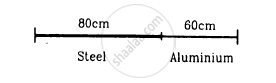
Figure shows an aluminium wire of length 60 cm joined to a steel wire of length 80 cm and stretched between two fixed supports. The tension produced is 40 N. The cross-sectional area of the steel wire is 1⋅0 mm2 and that of the aluminium wire is 3⋅0 mm2. What could be the minimum frequency of a tuning fork which can produce standing waves in the system with the joint as a node? The density of aluminium is 2⋅6 g cm−3 and that of steel is 7⋅8 g cm−3.
A 40 cm wire having a mass of 3⋅2 g is stretched between two fixed supports 40⋅05 cm apart. In its fundamental mode, the wire vibrates at 220 Hz. If the area of cross section of the wire is 1⋅0 mm2, find its Young modulus.
For the travelling harmonic wave
y (x, t) = 2.0 cos 2π (10t – 0.0080x + 0.35)
Where x and y are in cm and t in s. Calculate the phase difference between oscillatory motion of two points separated by a distance of `λ/2`.
Given below are some functions of x and t to represent the displacement of an elastic wave.
- y = 5 cos (4x) sin (20t)
- y = 4 sin (5x – t/2) + 3 cos (5x – t/2)
- y = 10 cos [(252 – 250) πt] cos [(252 + 250)πt]
- y = 100 cos (100πt + 0.5x)
State which of these represent
- a travelling wave along –x direction
- a stationary wave
- beats
- a travelling wave along +x direction.
Given reasons for your answers.
A wave of frequency υ = 1000 Hz, propagates at a velocity v = 700 m/sec along x-axis. Phase difference at a given point x during a time interval M = 0.5 × 10⁻³ sec is ______.
