Advertisements
Advertisements
Question
A travelling wave is produced on a long horizontal string by vibrating an end up and down sinusoidally. The amplitude of vibration is 1⋅0 and the displacement becomes zero 200 times per second. The linear mass density of the string is 0⋅10 kg m−1 and it is kept under a tension of 90 N. (a) Find the speed and the wavelength of the wave. (b) Assume that the wave moves in the positive x-direction and at t = 0, the end x = 0 is at its positive extreme position. Write the wave equation. (c) Find the velocity and acceleration of the particle at x = 50 cm at time t = 10 ms.
Advertisements
Solution
Given,
Amplitude of the wave = 1 cm
Frequency of the wave,
\[f = \frac{200}{2} = 100 \text{ Hz }\]
Mass per unit length, m = 0.1 kg/m
Applied tension, T = 90 N
(a) Velocity of the wave is given by
\[v = \sqrt{\frac{T}{m}}\]
Thus, we have:\[v = \sqrt{\left( \frac{90}{0 . 1} \right)} = 30 m/s\]
Now,
\[\text{ Wavelength, } \lambda = \frac{v}{f} = \frac{30}{100} = 0 . 3 m\]
\[ \Rightarrow \lambda = 30 cm\]
(b) At x = 0, displacement is maximum.
Thus, the wave equation is given by
\[y = \left( 1 cm \right)\cos2\pi\left\{ \left( \frac{t}{0 . 01 s} \right) - \left( \frac{x}{30 cm} \right) \right\}\] ...(1)
(c) Using \[\cos\left( - \theta \right) = \cos\theta\]
in equation (1), we get:
\[y = 1\cos2\pi\left( \frac{x}{30} - \frac{t}{0 . 01} \right)\]
\[Velocity, v = \frac{dy}{dt}\]
\[ \Rightarrow v = \left( \frac{2\pi}{0 . 01} \right)\sin2\pi\left\{ \frac{x}{30} - \frac{t}{0 . 01} \right\}\]
And,
Acceleration, \[a = \frac{d\nu}{dt}\]
\[ \Rightarrow a = \left\{ \frac{4 \pi^2}{\left( 0 . 01 \right)^2} \right\}\cos2\pi\left\{ \left( \frac{x}{30} \right) - \left( \frac{t}{0 . 01} \right) \right\}\]
\[\text{ When x = 50 cm, t = 10 ms = 10 \times {10}^{- 3} s .}\]
Now,
\[v = \left( \frac{2\pi}{0 . 01} \right)\sin2\pi\left\{ \left( \frac{5}{3} \right) - \left( \frac{0 . 01}{0 . 01} \right) \right\}\]
\[ = \left( \frac{2\pi}{0 . 01} \right)\sin\left( 2\pi \times \frac{2}{3} \right)\]
\[= - \left( \frac{2\pi}{0 . 01} \right)\sin\frac{4\pi}{3}\]
\[= - 200\pi\sin\frac{\pi}{3}\]
\[= - 200\pi \times \frac{\sqrt{3}}{2}\]
\[= - 544 cm/s\]
\[= - 5 . 4 m/s\]
In magnitude, v = 5.4 m/s.
Similarly,
\[a = \left\{ \frac{4 \pi^2}{\left( 0 . 01 \right)^2} \right\}\cos2\pi\left\{ \left( \frac{5}{3} \right) - 1 \right\}\]
\[ = 4 \pi^2 \times {10}^4 \times \frac{1}{2}\]
\[ \approx 2 \times {10}^5 cm/ s^2 \text{ or 2 km}/ s^2\]
APPEARS IN
RELATED QUESTIONS
You have learnt that a travelling wave in one dimension is represented by a function y= f (x, t)where x and t must appear in the combination x – v t or x + v t, i.e. y = f (x ± v t). Is the converse true? Examine if the following functions for y can possibly represent a travelling wave:
(a) `(x – vt )^2`
(b) `log [(x + vt)/x_0]`
(c) `1/(x + vt)`
(i) For the wave on a string described in Exercise 15.11, do all the points on the string oscillate with the same (a) frequency, (b) phase, (c) amplitude? Explain your answers. (ii) What is the amplitude of a point 0.375 m away from one end?
A train, standing at the outer signal of a railway station blows a whistle of frequency 400 Hz in still air. (i) What is the frequency of the whistle for a platform observer when the train (a) approaches the platform with a speed of 10 m s–1, (b) recedes from the platform with a speed of 10 m s–1? (ii) What is the speed of sound in each case? The speed of sound in still air can be taken as 340 m s–1.
A train, standing in a station-yard, blows a whistle of frequency 400 Hz in still air. The wind starts blowing in the direction from the yard to the station with at a speed of 10 m s–1. What are the frequency, wavelength, and speed of sound for an observer standing on the station’s platform? Is the situation exactly identical to the case when the air is still and the observer runs towards the yard at a speed of 10 m s–1? The speed of sound in still air can be taken as 340 m s–1.
Show that the particle speed can never be equal to the wave speed in a sine wave if the amplitude is less than wavelength divided by 2π.
Show that for a wave travelling on a string
\[\frac{y_{max}}{\nu_{max}} = \frac{\nu_{max}}{\alpha_{max}},\]
where the symbols have usual meanings. Can we use componendo and dividendo taught in algebra to write
\[\frac{y_{max} + \nu_{max}}{\nu_{max} - \nu_{max}} = \frac{\nu_{max} + \alpha_{max}}{\nu_{max} - \alpha_{max}}?\]
A sine wave is travelling in a medium. The minimum distance between the two particles, always having same speed, is
Choose the correct option:
Which of the following equations represents a wave travelling along Y-axis?
A sonometer wire of length l vibrates in fundamental mode when excited by a tuning fork of frequency 416. Hz. If the length is doubled keeping other things same, the string will ______.
A wave travels along the positive x-direction with a speed of 20 m s−1. The amplitude of the wave is 0⋅20 cm and the wavelength 2⋅0 cm. (a) Write the suitable wave equation which describes this wave. (b) What is the displacement and velocity of the particle at x= 2⋅0 cm at time t = 0 according to the wave equation written? Can you get different values of this quantity if the wave equation is written in a different fashion?
A string of length 40 cm and weighing 10 g is attached to a spring at one end and to a fixed wall at the other end. The spring has a spring constant of 160 N m−1 and is stretched by 1⋅0 cm. If a wave pulse is produced on the string near the wall, how much time will it take to reach the spring?
Two long strings A and B, each having linear mass density
\[1 \cdot 2 \times {10}^{- 2} kg m^{- 1}\] , are stretched by different tensions 4⋅8 N and 7⋅5 N respectively and are kept parallel to each other with their left ends at x = 0. Wave pulses are produced on the strings at the left ends at t = 0 on string A and at t = 20 ms on string B. When and where will the pulse on B overtake that on A?
Following figure shows two wave pulses at t = 0 travelling on a string in opposite directions with the same wave speed 50 cm s−1. Sketch the shape of the string at t = 4 ms, 6 ms, 8 ms, and 12 ms.
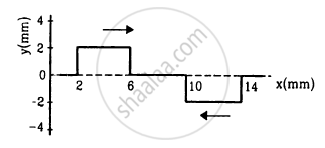
A 40 cm wire having a mass of 3⋅2 g is stretched between two fixed supports 40⋅05 cm apart. In its fundamental mode, the wire vibrates at 220 Hz. If the area of cross section of the wire is 1⋅0 mm2, find its Young modulus.
The string of a guitar is 80 cm long and has a fundamental frequency of 112 Hz. If a guitarist wishes to produce a frequency of 160 Hz, where should the person press the string?
For the travelling harmonic wave
y (x, t) = 2.0 cos 2π (10t – 0.0080x + 0.35)
Where x and y are in cm and t in s. Calculate the phase difference between oscillatory motion of two points separated by a distance of 4 m.
Sound waves of wavelength λ travelling in a medium with a speed of v m/s enter into another medium where its speed is 2v m/s. Wavelength of sound waves in the second medium is ______.
A sound wave is passing through air column in the form of compression and rarefaction. In consecutive compressions and rarefactions ______.
Given below are some functions of x and t to represent the displacement of an elastic wave.
- y = 5 cos (4x) sin (20t)
- y = 4 sin (5x – t/2) + 3 cos (5x – t/2)
- y = 10 cos [(252 – 250) πt] cos [(252 + 250)πt]
- y = 100 cos (100πt + 0.5x)
State which of these represent
- a travelling wave along –x direction
- a stationary wave
- beats
- a travelling wave along +x direction.
Given reasons for your answers.
The displacement y of a particle in a medium can be expressed as, y = `10^-6sin(100t + 20x + pi/4)` m where t is in second and x in meter. The speed of the wave is ______.
