Advertisements
Advertisements
Question
A 40 cm wire having a mass of 3⋅2 g is stretched between two fixed supports 40⋅05 cm apart. In its fundamental mode, the wire vibrates at 220 Hz. If the area of cross section of the wire is 1⋅0 mm2, find its Young modulus.
Advertisements
Solution
Given:
Length of the wire (L) = 40 cm = 0.40 m
Mass of the wire = 3.2 g = 0.003 kg
Distance between the two fixed supports of the wire = 40.05 cm
Fundamental mode frequency = 220 Hz
Therefore, linear mass density of the wire (m) is given by:
\[m = \frac{0 . 0032}{0 . 4} = 8 \times {10}^{- 3} kg/m\]
\[\text{ Change in length, } ∆ L = 40 . 05 - 40 = 0 . 05 cm\]
\[= 0 . 05 \times {10}^{- 2} m\]
\[Strain = \frac{∆ L}{L} = \frac{0 . 05 \times {10}^{- 2}}{0 . 4}\]
\[ = 0 . 125 \times {10}^{- 2} \]
\[ f_0 = \frac{1}{2L}\sqrt{\frac{T}{m}}\]
\[ = \frac{1}{2 \times \left( 0 . 4005 \right)} \sqrt{\frac{T}{8 \times {10}^{- 3}}}\]
\[\Rightarrow 220 \times 220 = \left[ \frac{1}{\left( 0 . 801 \right)^2} \right] \times T \times \left( \frac{{10}^3}{8} \right)\]
\[ \Rightarrow T \times 1000 = 220 \times 220 \times 0 . 641 \times 0 . 8\]
\[ \Rightarrow T = 248 . 19 N\]
\[Stress = \frac{Tension}{Area} = \frac{248 . 19}{1 {mm}^2} = \frac{248 . 19}{{10}^{- 6}}\]
\[ \Rightarrow Stress = 248 . 19 \times {10}^6 \]
\[\text{ Young's modulus, } Y = \frac{stress}{strain}\]
\[ = \frac{248 . 19 \times {10}^6}{0 . 125 \times {10}^{- 2}}\]
\[ \Rightarrow Y = 19852 \times {10}^8 \]
\[ = 1 . 985 \times {10}^{11} N/ m^2\]
Hence, the required Young's modulus of the wire is
\[1 . 985 \times {10}^{11} N/ m^2\]
APPEARS IN
RELATED QUESTIONS
You have learnt that a travelling wave in one dimension is represented by a function y= f (x, t)where x and t must appear in the combination x – v t or x + v t, i.e. y = f (x ± v t). Is the converse true? Examine if the following functions for y can possibly represent a travelling wave:
(a) `(x – vt )^2`
(b) `log [(x + vt)/x_0]`
(c) `1/(x + vt)`
For the wave described in Exercise 15.8, plot the displacement (y) versus (t) graphs for x = 0, 2 and 4 cm. What are the shapes of these graphs? In which aspects does the oscillatory motion in travelling wave differ from one point to another: amplitude, frequency or phase?
A wire stretched between two rigid supports vibrates in its fundamental mode with a frequency of 45 Hz. The mass of the wire is 3.5 × 10⁻² kg and its linear mass density is 4.0 × 10⁻² kg m–1. What is (a) the speed of a transverse wave on the string, and (b) the tension in the string?
Show that for a wave travelling on a string
\[\frac{y_{max}}{\nu_{max}} = \frac{\nu_{max}}{\alpha_{max}},\]
where the symbols have usual meanings. Can we use componendo and dividendo taught in algebra to write
\[\frac{y_{max} + \nu_{max}}{\nu_{max} - \nu_{max}} = \frac{\nu_{max} + \alpha_{max}}{\nu_{max} - \alpha_{max}}?\]
A wave pulse, travelling on a two-piece string, gets partially reflected and partially transmitted at the junction. The reflected wave is inverted in shape as compared to the incident one. If the incident wave has wavelength λ and the transmitted wave λ'
A 200 Hz wave with amplitude 1 mm travels on a long string of linear mass density 6 g m−1 kept under a tension of 60 N. (a) Find the average power transmitted across a given point on the string. (b) Find the total energy associated with the wave in a 2⋅0 m long portion of the string.
Following figure shows two wave pulses at t = 0 travelling on a string in opposite directions with the same wave speed 50 cm s−1. Sketch the shape of the string at t = 4 ms, 6 ms, 8 ms, and 12 ms.
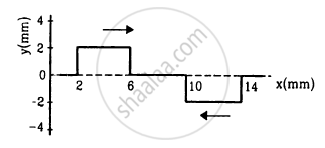
A wire of length 2⋅00 m is stretched to a tension of 160 N. If the fundamental frequency of vibration is 100 Hz, find its linear mass density.
The string of a guitar is 80 cm long and has a fundamental frequency of 112 Hz. If a guitarist wishes to produce a frequency of 160 Hz, where should the person press the string?
A man standing unsymmetrical position between two mountains and fires a gun. He hears the first echo after 1.5 s and the second echo after 2.5 s. If the speed of sound in air is 340 m/s, then the distance between the mountains will be ______
An organ pipe of length 0.4 m is open at both ends. The speed of sound in the air is 340 m/s. The fundamental frequency is ______
A string 1 m long is fixed at one end. The other end is moved up and down with a frequency of 20 Hz. Due to this, a stationary wave with four complete loops gets produced on the string. Find the speed of the progressive wave which produces the stationary wave.
Use the formula `v = sqrt((gamma P)/rho)` to explain why the speed of sound in air is independent of pressure.
A bat emits an ultrasonic sound of frequency 1000 kHz in the air. If the sound meets a water surface, what is the wavelength of the the reflected sound? The speed of sound in air is 340 m s–1 and in water 1486 m s–1.
Sound waves of wavelength λ travelling in a medium with a speed of v m/s enter into another medium where its speed is 2v m/s. Wavelength of sound waves in the second medium is ______.
Speed of sound wave in air ______.
The amplitude of wave disturbance propagating in the positive x-direction given is by `1/(1 + x)^2` at time t = 0 and `1/(1 + (x - 2)^2)` at t = 1 s, where x and y are in 2 metres. The shape of wave does not change during the propagation. The velocity of the wave will be ______ m/s.
An engine is approaching a cliff at a constant speed. When it is at a distance of 0.9 km from cliff it sounds a whistle. The echo of the sound is heard by the driver after 5 seconds. Velocity of sound in air is equal to 330 ms-1. The speed of the engine is ______ km/h.
