Advertisements
Advertisements
प्रश्न
A string of length L fixed at both ends vibrates in its fundamental mode at a frequency ν and a maximum amplitude A. (a)
- Find the wavelength and the wave number k.
- Take the origin at one end of the string and the X-axis along the string. Take the Y-axis along the direction of the displacement. Take t = 0 at the instant when the middle point of the string passes through its mean position and is going towards the positive y-direction. Write the equation describing the standing wave.
Advertisements
उत्तर
Given:
Length of the string = L
Velocity of wave is given as:
\[V = \sqrt{\frac{T}{m}}\]
(a) \[\text{Wavelength}, \lambda = \frac{\text{Velocity}}{\text{Frequency}}\]
\[\Rightarrow \lambda = \frac{\sqrt{\frac{T}{m}}}{\frac{1}{2L}\sqrt{\frac{T}{m}}} = 2L\]
\[\text{ Wave number,} K = \frac{2\pi}{\lambda} = \frac{2\pi}{2L} = \frac{\pi}{L}\]
(b) Equation of the stationary wave:
We have `y = Asin (2pix)/lambda * cos(omegat + phi)`
Given, At t = 0
`x = L/2`
y = 0
∴` 0 = Asin (2piL/2)/(2L)cos(0 + phi)`
or cos Φ = 0
or Φ = π/2
Now,
`y = Asin (2pix)/(2L)cos(2 pi f t + pi/2)`
= `Asin(pix)/Lsin(2 pi f t)`
APPEARS IN
संबंधित प्रश्न
Explain what is Doppler effect in sound
What is the smallest positive phase constant which is equivalent to 7⋅5 π?
If you are walking on the moon, can you hear the sound of stones cracking behind you? Can you hear the sound of your own footsteps?
Can you hear your own words if you are standing in a perfect vacuum? Can you hear your friend in the same conditions?
When sound wave is refracted from air to water, which of the following will remain unchanged?
When two waves with same frequency and constant phase difference interfere,
A tuning fork of frequency 512 Hz is vibrated with a sonometer wire and 6 beats per second are heard. The beat frequency reduces if the tension in the string is slightly increased. The original frequency of vibration of the string is
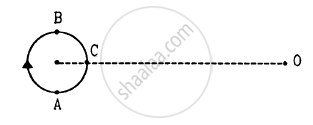
A small source of sounds moves on a circle as shown in figure and an observer is sitting at O. Let \[v_1, v_2, v_3\] be the frequencies heard when the source is at A, B and C respectively.
When you speak to your friend, which of the following parameters have a unique value in the sound produced?
A source of sound moves towards an observer.
Find the minimum and maximum wavelengths of sound in water that is in the audible range (20−20000 Hz) for an average human ear. Speed of sound in water = 1450 m s−1.
A sound wave frequency 100 Hz is travelling in air. The speed of sound in air is 350 m s−1. (a) By how much is the phase changed at a given point in 2.5 ms? (b) What is the phase difference at a given instant between two points separated by a distance of 10.0 cm along the direction of propagation?
The length of the wire shown in figure between the pulley is 1⋅5 m and its mass is 12⋅0 g. Find the frequency of vibration with which the wire vibrates in two loops leaving the middle point of the wire between the pulleys at rest.

A string, fixed at both ends, vibrates in a resonant mode with a separation of 2⋅0 cm between the consecutive nodes. For the next higher resonant frequency, this separation is reduced to 1⋅6 cm. Find the length of the string.
If the sound level in a room is increased from 50 dB to 60 dB, by what factor is the pressure amplitude increased?
The noise level in a classroom in absence of the teacher is 50 dB when 50 students are present. Assuming that on the average each student output same sound energy per second, what will be the noise level if the number of students is increased to 100?
Three sources of sound S1, S2 and S3 of equal intensity are placed in a straight line with S1S2 = S2S3. At a point P, far away from the sources, the wave coming from S2 is 120° ahead in phase of that from S1. Also, the wave coming from S3 is 120° ahead of that from S2. What would be the resultant intensity of sound at P?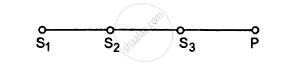
Two coherent narrow slits emitting sound of wavelength λ in the same phase are placed parallel to each other at a small separation of 2λ. The sound is detected by moving a detector on the screen ∑ at a distance D(>>λ) from the slit S1 as shown in figure. Find the distance x such that the intensity at P is equal to the intensity at O.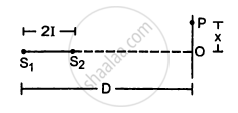
For the propagation of longitudinal waves, the medium must have
- elasticity
- mass
- inertia
- force of cohesion
With propagation of longitudinal waves through a medium, the quantity transmitted is ______.
