Advertisements
Advertisements
प्रश्न
Two coherent narrow slits emitting sound of wavelength λ in the same phase are placed parallel to each other at a small separation of 2λ. The sound is detected by moving a detector on the screen ∑ at a distance D(>>λ) from the slit S1 as shown in figure. Find the distance x such that the intensity at P is equal to the intensity at O.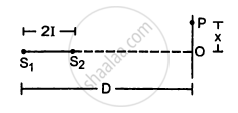
Advertisements
उत्तर
Given:
S1& S2 are in the same phase. At O, there will be maximum intensity.
There will be maximum intensity at P.
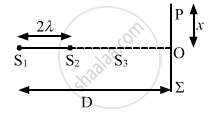
\[∆ S_1 PO\] and \[∆ S_2 PO\] are right-angled triangles.
So,
\[\left( S_1 P \right)^2 - \left( S_2 P \right)^2 \]
\[ = \left[ D^2 + x^2 \right] - \left[ \left( D - 2\lambda \right)^2 + x^2 \right]^2 \]
\[ = 4\lambda D + 4 \lambda^2 = 4\lambda D\]
\[( \lambda^2 \text { is small and can be neglected })\]
\[ \Rightarrow \left( S_1 P + S_2 P \right)\left( S_1 P - S_2 P \right) = 4\lambda D\]
\[ \Rightarrow \left( S_1 P - S_2 P \right) = \frac{4\lambda D}{\left( S_1 P + S_2 P \right)}\]
\[ \Rightarrow S_1 P - S_2 P = \frac{4\lambda D}{2\sqrt{x^2 + D^2}}\]
For constructive interference, path difference = n \[\lambda\]
So,
\[\Rightarrow S_1 P - S_2 P = \frac{4\lambda D}{2\sqrt{x^2 + D^2}} = n\lambda\]
\[ \Rightarrow \frac{2D}{\sqrt{x^2 + D^2}} = n\]
\[ \Rightarrow n^2 ( x^2 + D^2 ) = 4 D^2 \]
\[ \Rightarrow n^2 x^2 + n^2 D^2 = 4 D^2 \]
\[ \Rightarrow n^2 x^2 = 4 D^2 - n^2 D^2 \]
\[ \Rightarrow n^2 x^2 = D^2 \left( 4 - n^2 \right)\]
\[ \Rightarrow x = \frac{D}{n}\sqrt{4 - n^2}\]
\[\text { When n = 1 }, \]
\[x = \sqrt{3}D (\text { 1st order }) . \]
\[\text { When n } = 2, \]
\[x = 0 \ (\text { 2nd order }) . \]
So, when x = \[\sqrt{3}D\] , the intensity at P is equal to the intensity at O.
APPEARS IN
संबंधित प्रश्न
The equation \[y = A \sin^2 \left( kx - \omega t \right)\]
represents a wave motion with
Two loudspeakers are arranged facing each other at some distance. Will a person standing behind one of the loudspeakers clearly hear the sound of the other loudspeaker or the clarity will be seriously damaged because of the 'collision' of the two sounds in between?
The bulk modulus and the density of water are greater than those of air. With this much of information, we can say that velocity of sound in air
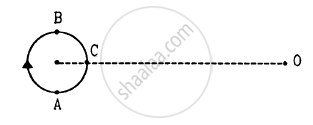
A small source of sounds moves on a circle as shown in figure and an observer is sitting at O. Let \[v_1, v_2, v_3\] be the frequencies heard when the source is at A, B and C respectively.
When you speak to your friend, which of the following parameters have a unique value in the sound produced?
The fundamental frequency of a vibrating organ pipe is 200 Hz.
(a) The first overtone is 400 Hz.
(b) The first overtone may be 400 Hz.
(c) The first overtone may be 600 Hz.
(d) 600 Hz is an overtone.
Sound waves from a loudspeaker spread nearly uniformly in all directions if the wavelength of the sound is much larger than the diameter of the loudspeaker. (a)Calculate the frequency for which the wavelength of sound in air is ten times the diameter of the speaker if the diameter is 20 cm. (b) Sound is essentially transmitted in the forward direction if the wavelength is much shorter than the diameter of the speaker. Calculate the frequency at which the wavelength of the sound is one tenth of the diameter of the speaker described above. Take the speed of sound to be 340 m/s.
At what temperature will the speed of sound be double of its value at 0°C?
The absolute temperature of air in a region linearly increases from T1 to T2 in a space of width d. Find the time taken by a sound wave to go through the region in terms of T1, T2, d and the speed v of sound at 273 K. Evaluate this time for T1 = 280 K, T2 = 310 K, d = 33 m and v = 330 m s−1.
Calculate the bulk modulus of air from the following data about a sound wave of wavelength 35 cm travelling in air. The pressure at a point varies between (1.0 × 10⁵ ± 14) Pa and the particles of the air vibrate in simple harmonic motion of amplitude 5.5 × 10⁻⁶ m.
A sources of sound operates at 2.0 kHz, 20 W emitting sound uniformly in all directions. The speed of sound in air is 340 m s−1 and the density of air is 1.2 kg m −3. (a) What is the intensity at a distance of 6.0 m from the source? (b) What will be the pressure amplitude at this point? (c) What will be the displacement amplitude at this point?
A string, fixed at both ends, vibrates in a resonant mode with a separation of 2⋅0 cm between the consecutive nodes. For the next higher resonant frequency, this separation is reduced to 1⋅6 cm. Find the length of the string.
If the sound level in a room is increased from 50 dB to 60 dB, by what factor is the pressure amplitude increased?
Show that if the room temperature changes by a small amount from T to T + ∆T, the fundamental frequency of an organ pipe changes from v to v + ∆v, where \[\frac{∆ v}{v} = \frac{1}{2}\frac{∆ T}{T} .\]
Two electric trains run at the same speed of 72 km h−1 along the same track and in the same direction with separation of 2.4 km between them. The two trains simultaneously sound brief whistles. A person is situated at a perpendicular distance of 500 m from the track and is equidistant from the two trains at the instant of the whistling. If both the whistles were at 500 Hz and the speed of sound in air is 340 m s−1, find the frequencies heard by the person.
A source of sound emitting a 1200 Hz note travels along a straight line at a speed of 170 m s−1. A detector is placed at a distance 200 m from the line of motion of the source. (a) Find the frequency of sound receive by the detector at the instant when the source gets closest to it. (b) Find the distance between the source and the detector at the instant in detects the frequency 1200 Hz. Velocity of sound in air = 340 m s−1.
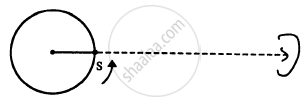
A small source of sound S of frequency 500 Hz is attached to the end of a light string and is whirled in a vertical circle of radius 1.6 m. The string just remains tight when the source is at the highest point. (a) An observer is located in the same vertical plane at a large distance and at the same height as the centre of the circle. The speed of sound in air = 330 m s−1 and g = 10 m s−2. Find the maximum frequency heard by the observer. (b) An observer is situated at a large distance vertically above the centre of the circle. Find the frequency heard by the observer corresponding to the sound emitted by the source when it is at the same height as the centre.