Advertisements
Advertisements
Question
Two coherent narrow slits emitting sound of wavelength λ in the same phase are placed parallel to each other at a small separation of 2λ. The sound is detected by moving a detector on the screen ∑ at a distance D(>>λ) from the slit S1 as shown in figure. Find the distance x such that the intensity at P is equal to the intensity at O.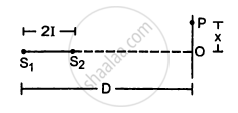
Advertisements
Solution
Given:
S1& S2 are in the same phase. At O, there will be maximum intensity.
There will be maximum intensity at P.
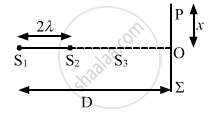
\[∆ S_1 PO\] and \[∆ S_2 PO\] are right-angled triangles.
So,
\[\left( S_1 P \right)^2 - \left( S_2 P \right)^2 \]
\[ = \left[ D^2 + x^2 \right] - \left[ \left( D - 2\lambda \right)^2 + x^2 \right]^2 \]
\[ = 4\lambda D + 4 \lambda^2 = 4\lambda D\]
\[( \lambda^2 \text { is small and can be neglected })\]
\[ \Rightarrow \left( S_1 P + S_2 P \right)\left( S_1 P - S_2 P \right) = 4\lambda D\]
\[ \Rightarrow \left( S_1 P - S_2 P \right) = \frac{4\lambda D}{\left( S_1 P + S_2 P \right)}\]
\[ \Rightarrow S_1 P - S_2 P = \frac{4\lambda D}{2\sqrt{x^2 + D^2}}\]
For constructive interference, path difference = n \[\lambda\]
So,
\[\Rightarrow S_1 P - S_2 P = \frac{4\lambda D}{2\sqrt{x^2 + D^2}} = n\lambda\]
\[ \Rightarrow \frac{2D}{\sqrt{x^2 + D^2}} = n\]
\[ \Rightarrow n^2 ( x^2 + D^2 ) = 4 D^2 \]
\[ \Rightarrow n^2 x^2 + n^2 D^2 = 4 D^2 \]
\[ \Rightarrow n^2 x^2 = 4 D^2 - n^2 D^2 \]
\[ \Rightarrow n^2 x^2 = D^2 \left( 4 - n^2 \right)\]
\[ \Rightarrow x = \frac{D}{n}\sqrt{4 - n^2}\]
\[\text { When n = 1 }, \]
\[x = \sqrt{3}D (\text { 1st order }) . \]
\[\text { When n } = 2, \]
\[x = 0 \ (\text { 2nd order }) . \]
So, when x = \[\sqrt{3}D\] , the intensity at P is equal to the intensity at O.
APPEARS IN
RELATED QUESTIONS
Explain what is Doppler effect in sound
The wavelengths of two sound waves in air are `81/173`m and `81/170`m. They produce 10 beats per second. Calculate the velocity of sound in air
A string clamped at both ends vibrates in its fundamental mode. Is there any position (except the ends) on the string which can be touched without disturbing the motion? What if the string vibrates in its first overtone?
Two sound waves move in the same direction in the same medium. The pressure amplitudes of the waves are equal but the wavelength of the first wave is double the second. Let the average power transmitted across a cross section by the first wave be P1 and that by the second wave be P2. Then
When two waves with same frequency and constant phase difference interfere,
When you speak to your friend, which of the following parameters have a unique value in the sound produced?
A source of sound moves towards an observer.
The equation of a travelling sound wave is y = 6.0 sin (600 t − 1.8 x) where y is measured in 10−5 m, t in second and x in metre. (a) Find the ratio of the displacement amplitude of the particles to the wavelength of the wave. (b) Find the ratio of the velocity amplitude of the particles to the wave speed.
The absolute temperature of air in a region linearly increases from T1 to T2 in a space of width d. Find the time taken by a sound wave to go through the region in terms of T1, T2, d and the speed v of sound at 273 K. Evaluate this time for T1 = 280 K, T2 = 310 K, d = 33 m and v = 330 m s−1.
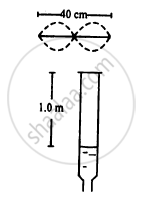
The length of the wire shown in figure between the pulley is 1⋅5 m and its mass is 12⋅0 g. Find the frequency of vibration with which the wire vibrates in two loops leaving the middle point of the wire between the pulleys at rest.
The intensity of sound from a point source is 1.0 × 10⁻⁸ W m−2 at a distance of 5.0 m from the source. What will be the intensity at a distance of 25 m from the source?
The sound level at a point 5.0 m away from a point source is 40 dB. What will be the level at a point 50 m away from the source?
If the sound level in a room is increased from 50 dB to 60 dB, by what factor is the pressure amplitude increased?
A string of length L fixed at both ends vibrates in its fundamental mode at a frequency ν and a maximum amplitude A. (a)
- Find the wavelength and the wave number k.
- Take the origin at one end of the string and the X-axis along the string. Take the Y-axis along the direction of the displacement. Take t = 0 at the instant when the middle point of the string passes through its mean position and is going towards the positive y-direction. Write the equation describing the standing wave.
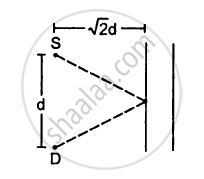
A source S and a detector D are placed at a distance d apart. A big cardboard is placed at a distance \[\sqrt{2}d\] from the source and the detector as shown in figure. The source emits a wave of wavelength = d/2 which is received by the detector after reflection from the cardboard. It is found to be in phase with the direct wave received from the source. By what minimum distance should the cardboard be shifted away so that the reflected wave becomes out of phase with the direct wave?
Consider the situation shown in the figure.The wire which has a mass of 4.00 g oscillates in its second harmonic and sets the air column in the tube into vibrations in its fundamental mode. Assuming that the speed of sound in air is 340 m s−1, find the tension in the wire.
Show that if the room temperature changes by a small amount from T to T + ∆T, the fundamental frequency of an organ pipe changes from v to v + ∆v, where \[\frac{∆ v}{v} = \frac{1}{2}\frac{∆ T}{T} .\]
A tuning fork of frequency 256 Hz produces 4 beats per second with a wire of length 25 cm vibrating in its fundamental mode. The beat frequency decreases when the length is slightly shortened. What could be the minimum length by which the wire we shortened so that it produces no beats with the tuning fork?
A person standing on a road sends a sound signal to the driver of a car going away from him at a speed of 72 km h−1. The signal travelling at 330 m s−1 in air and having a frequency of 1600 Hz gets reflected from the body of the car and returns. Find the frequency of the reflected signal as heard by the person.
The speed of a wave in a string is 20 m/s and the frequency is 50 Hz. The phase difference between two points on the string 10 cm apart will be ______.
