Advertisements
Advertisements
Question
The sound level at a point 5.0 m away from a point source is 40 dB. What will be the level at a point 50 m away from the source?
Advertisements
Solution
Let
\[\beta_A\] be the sound level at a point 5 m (= r1) away from the point source and
∴\[\beta_A\]= 40 dB
Sound level is given by:
\[\beta_A = 10 \log_{10} \left( \frac{I_A}{I_0} \right) . \]
\[ \Rightarrow \frac{I_A}{I_0} = {10}^\left( \frac{\beta_A}{10} \right) . . . . . \left( 1 \right)\]
\[ \beta_B = 10 \log_{10} \left( \frac{I_B}{I_o} \right)\]
\[ \Rightarrow \frac{I_B}{I_0} = {10}^\left( \frac{\beta_B}{10} \right) . . . . . \left( 2 \right)\]
\[\text { From } \left( 1 \right) \text { and } \left( 2 \right), \text { we get: }\]
\[ \frac{I_A}{I_B} = {10}^\left( \frac{\beta_A - \beta_B}{10} \right) . . . . \left( 3 \right)\]
\[\text { Also }, \]
\[ \frac{I_A}{I_B} = \frac{r_B^2}{r_A^2} = \left( \frac{50}{5} \right)^2 = {10}^2 . . . . . \left( 4 \right)\]
\[\text { From } \left( 3 \right) \text { and } \left( 4 \right), \text{ we get: }\]
\[ {10}^2 = {10}^\left( \frac{\beta_A - \beta_B}{10} \right) \]
\[ \Rightarrow \frac{\beta_A - \beta_B}{10} = 2 \]
\[ \Rightarrow \beta_A - \beta_B = 20\]
\[ \Rightarrow \beta_B = 40 - 20 = 20 dB\]
\[\beta_A = 10 \log_{10} \left( \frac{I_A}{I_0} \right) . \]
\[ \Rightarrow \frac{I_A}{I_0} = {10}^\left( \frac{\beta_A}{10} \right) . . . . . \left( 1 \right)\]
\[ \beta_B = 10 \log_{10} \left( \frac{I_B}{I_o} \right)\]
\[ \Rightarrow \frac{I_B}{I_0} = {10}^\left( \frac{\beta_B}{10} \right) . . . . . \left( 2 \right)\]
\[\text { From }\left( 1 \right) \text{ and } \left( 2 \right), \text { we get: }\]
\[ \frac{I_A}{I_B} = {10}^\left( \frac{\beta_A - \beta_B}{10} \right) . . . . \left( 3 \right)\]
\[\text { Also }, \]
\[ \frac{I_A}{I_B} = \frac{r_B^2}{r_A^2} = \left( \frac{50}{5} \right)^2 = {10}^2 . . . . . \left( 4 \right)\]
\[\text { From } \left( 3 \right) \text { and } \left( 4 \right), \text { we get: } \]
\[ {10}^2 = {10}^\left( \frac{\beta_A - \beta_B}{10} \right) \]
\[ \Rightarrow \frac{\beta_A - \beta_B}{10} = 2 \]
\[ \Rightarrow \beta_A - \beta_B = 20\]
\[ \Rightarrow \beta_B = 40 - 20 = 20 dB\]
Thus, the sound level of a point 50 m away from the point source is 20 dB.
APPEARS IN
RELATED QUESTIONS
A wave is represented by an equation \[y = c_1 \sin \left( c_2 x + c_3 t \right)\] In which direction is the wave going? Assume that \[c_1 , c_2\] \[c_3\] are all positive.
What is the smallest positive phase constant which is equivalent to 7⋅5 π?
The bulk modulus and the density of water are greater than those of air. With this much of information, we can say that velocity of sound in air
A listener is at rest with respect to the source of sound. A wind starts blowing along the line joining the source and the observer. Which of the following quantities do not change?
(a) Frequency
(b) Velocity of sound
(c) Wavelength
(d) Time period
Find the minimum and maximum wavelengths of sound in water that is in the audible range (20−20000 Hz) for an average human ear. Speed of sound in water = 1450 m s−1.
Ultrasonic waves of frequency 4.5 MHz are used to detect tumour in soft tissue. The speed of sound in tissue is 1.5 km s−1 and that in air is 340 m s−1. Find the wavelength of this ultrasonic wave in air and in tissue.
The equation of a travelling sound wave is y = 6.0 sin (600 t − 1.8 x) where y is measured in 10−5 m, t in second and x in metre. (a) Find the ratio of the displacement amplitude of the particles to the wavelength of the wave. (b) Find the ratio of the velocity amplitude of the particles to the wave speed.
At what temperature will the speed of sound be double of its value at 0°C?
A sources of sound operates at 2.0 kHz, 20 W emitting sound uniformly in all directions. The speed of sound in air is 340 m s−1 and the density of air is 1.2 kg m −3. (a) What is the intensity at a distance of 6.0 m from the source? (b) What will be the pressure amplitude at this point? (c) What will be the displacement amplitude at this point?
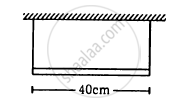
A uniform horizontal rod of length 40 cm and mass 1⋅2 kg is supported by two identical wires as shown in figure. Where should a mass of 4⋅8 kg be placed on the rod so that the same tuning fork may excite the wire on left into its fundamental vibrations and that on right into its first overtone? Take g = 10 m s−2.
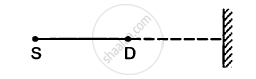
A source of sound S and detector D are placed at some distance from one another. a big cardboard is placed near hte detector and perpendicular to the line SD as shown in figure. It is gradually moved away and it is found that the intensity changes from a maximum to a minimum as the board is moved through a distance of 20 cm. Find the frequency of the sound emitted. Velocity of sound in air is 336 m s−1.
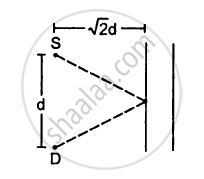
A source S and a detector D are placed at a distance d apart. A big cardboard is placed at a distance \[\sqrt{2}d\] from the source and the detector as shown in figure. The source emits a wave of wavelength = d/2 which is received by the detector after reflection from the cardboard. It is found to be in phase with the direct wave received from the source. By what minimum distance should the cardboard be shifted away so that the reflected wave becomes out of phase with the direct wave?
Two speakers S1 and S2, driven by the same amplifier, are placed at y = 1.0 m and y = −1.0 m(See figure). The speakers vibrate in phase at 600 Hz. A man stands at a point on the X-axis at a very large distance from the origin and starts moving parallel to the Y-axis. The speed of sound in air is 330 m s−1. (a) At what angle θ will the intensity of sound drop to a minimum for the first time? (b) At what angle will he hear a maximum of sound intensity for the first time? (c) If he continues to walk along the line, how many more can he hear?
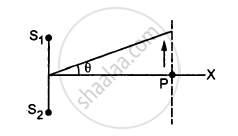
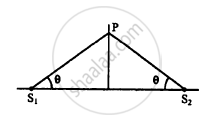
Two sources of sound S1 and S2 vibrate at same frequency and are in phase. The intensity of sound detected at a point P as shown in the figure is I0. (a) If θ equals 45°, what will be the intensity of sound detected at this point if one of the sources is switched off? (b) What will be the answer of the previous part if θ = 60°?
The separation between a node and the next antinode in a vibrating air column is 25 cm. If the speed of sound in air is 340 m s−1, find the frequency of vibration of the air column.
A traffic policeman standing on a road sounds a whistle emitting the main frequency of 2.00 kHz. What could be the apparent frequency heard by a scooter-driver approaching the policeman at a speed of 36.0 km h−1? Speed of sound in air = 340 m s−1.
A sound source, fixed at the origin, is continuously emitting sound at a frequency of 660 Hz. The sound travels in air at a speed of 330 m s−1. A listener is moving along the lien x= 336 m at a constant speed of 26 m s−1. Find the frequency of the sound as observed by the listener when he is (a) at y = − 140 m, (b) at y = 0 and (c) at y = 140 m.
A car moves with a speed of 54 km h−1 towards a cliff. The horn of the car emits sound of frequency 400 Hz at a speed of 335 m s−1. (a) Find the wavelength of the sound emitted by the horn in front of the car. (b) Find the wavelength of the wave reflected from the cliff. (c) What frequency does a person sitting in the car hear for the reflected sound wave? (d) How many beats does he hear in 10 seconds between the sound coming directly from the horn and that coming after the reflection?
A source of sound emitting a 1200 Hz note travels along a straight line at a speed of 170 m s−1. A detector is placed at a distance 200 m from the line of motion of the source. (a) Find the frequency of sound receive by the detector at the instant when the source gets closest to it. (b) Find the distance between the source and the detector at the instant in detects the frequency 1200 Hz. Velocity of sound in air = 340 m s−1.
With propagation of longitudinal waves through a medium, the quantity transmitted is ______.
