Advertisements
Advertisements
प्रश्न
The sound level at a point 5.0 m away from a point source is 40 dB. What will be the level at a point 50 m away from the source?
Advertisements
उत्तर
Let
\[\beta_A\] be the sound level at a point 5 m (= r1) away from the point source and
∴\[\beta_A\]= 40 dB
Sound level is given by:
\[\beta_A = 10 \log_{10} \left( \frac{I_A}{I_0} \right) . \]
\[ \Rightarrow \frac{I_A}{I_0} = {10}^\left( \frac{\beta_A}{10} \right) . . . . . \left( 1 \right)\]
\[ \beta_B = 10 \log_{10} \left( \frac{I_B}{I_o} \right)\]
\[ \Rightarrow \frac{I_B}{I_0} = {10}^\left( \frac{\beta_B}{10} \right) . . . . . \left( 2 \right)\]
\[\text { From } \left( 1 \right) \text { and } \left( 2 \right), \text { we get: }\]
\[ \frac{I_A}{I_B} = {10}^\left( \frac{\beta_A - \beta_B}{10} \right) . . . . \left( 3 \right)\]
\[\text { Also }, \]
\[ \frac{I_A}{I_B} = \frac{r_B^2}{r_A^2} = \left( \frac{50}{5} \right)^2 = {10}^2 . . . . . \left( 4 \right)\]
\[\text { From } \left( 3 \right) \text { and } \left( 4 \right), \text{ we get: }\]
\[ {10}^2 = {10}^\left( \frac{\beta_A - \beta_B}{10} \right) \]
\[ \Rightarrow \frac{\beta_A - \beta_B}{10} = 2 \]
\[ \Rightarrow \beta_A - \beta_B = 20\]
\[ \Rightarrow \beta_B = 40 - 20 = 20 dB\]
\[\beta_A = 10 \log_{10} \left( \frac{I_A}{I_0} \right) . \]
\[ \Rightarrow \frac{I_A}{I_0} = {10}^\left( \frac{\beta_A}{10} \right) . . . . . \left( 1 \right)\]
\[ \beta_B = 10 \log_{10} \left( \frac{I_B}{I_o} \right)\]
\[ \Rightarrow \frac{I_B}{I_0} = {10}^\left( \frac{\beta_B}{10} \right) . . . . . \left( 2 \right)\]
\[\text { From }\left( 1 \right) \text{ and } \left( 2 \right), \text { we get: }\]
\[ \frac{I_A}{I_B} = {10}^\left( \frac{\beta_A - \beta_B}{10} \right) . . . . \left( 3 \right)\]
\[\text { Also }, \]
\[ \frac{I_A}{I_B} = \frac{r_B^2}{r_A^2} = \left( \frac{50}{5} \right)^2 = {10}^2 . . . . . \left( 4 \right)\]
\[\text { From } \left( 3 \right) \text { and } \left( 4 \right), \text { we get: } \]
\[ {10}^2 = {10}^\left( \frac{\beta_A - \beta_B}{10} \right) \]
\[ \Rightarrow \frac{\beta_A - \beta_B}{10} = 2 \]
\[ \Rightarrow \beta_A - \beta_B = 20\]
\[ \Rightarrow \beta_B = 40 - 20 = 20 dB\]
Thus, the sound level of a point 50 m away from the point source is 20 dB.
APPEARS IN
संबंधित प्रश्न
The voice of a person, who has inhaled helium, has a remarkably high pitch. Explain on the basis of resonant vibration of vocal cord filled with air and with helium.
When sound wave is refracted from air to water, which of the following will remain unchanged?
When you speak to your friend, which of the following parameters have a unique value in the sound produced?
The fundamental frequency of a vibrating organ pipe is 200 Hz.
(a) The first overtone is 400 Hz.
(b) The first overtone may be 400 Hz.
(c) The first overtone may be 600 Hz.
(d) 600 Hz is an overtone.
Ultrasonic waves of frequency 4.5 MHz are used to detect tumour in soft tissue. The speed of sound in tissue is 1.5 km s−1 and that in air is 340 m s−1. Find the wavelength of this ultrasonic wave in air and in tissue.
At what temperature will the speed of sound be double of its value at 0°C?
A sources of sound operates at 2.0 kHz, 20 W emitting sound uniformly in all directions. The speed of sound in air is 340 m s−1 and the density of air is 1.2 kg m −3. (a) What is the intensity at a distance of 6.0 m from the source? (b) What will be the pressure amplitude at this point? (c) What will be the displacement amplitude at this point?
A particular guitar wire is 30⋅0 cm long and vibrates at a frequency of 196 Hz when no finger is placed on it. The next higher notes on the scale are 220 Hz, 247 Hz, 262 Hz and 294 Hz. How far from the end of the string must the finger be placed to play these notes?
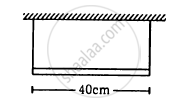
A uniform horizontal rod of length 40 cm and mass 1⋅2 kg is supported by two identical wires as shown in figure. Where should a mass of 4⋅8 kg be placed on the rod so that the same tuning fork may excite the wire on left into its fundamental vibrations and that on right into its first overtone? Take g = 10 m s−2.
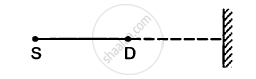
A source of sound S and detector D are placed at some distance from one another. a big cardboard is placed near hte detector and perpendicular to the line SD as shown in figure. It is gradually moved away and it is found that the intensity changes from a maximum to a minimum as the board is moved through a distance of 20 cm. Find the frequency of the sound emitted. Velocity of sound in air is 336 m s−1.
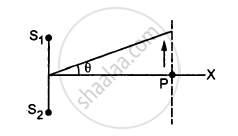
Two speakers S1 and S2, driven by the same amplifier, are placed at y = 1.0 m and y = −1.0 m(See figure). The speakers vibrate in phase at 600 Hz. A man stands at a point on the X-axis at a very large distance from the origin and starts moving parallel to the Y-axis. The speed of sound in air is 330 m s−1. (a) At what angle θ will the intensity of sound drop to a minimum for the first time? (b) At what angle will he hear a maximum of sound intensity for the first time? (c) If he continues to walk along the line, how many more can he hear?
Three sources of sound S1, S2 and S3 of equal intensity are placed in a straight line with S1S2 = S2S3. At a point P, far away from the sources, the wave coming from S2 is 120° ahead in phase of that from S1. Also, the wave coming from S3 is 120° ahead of that from S2. What would be the resultant intensity of sound at P?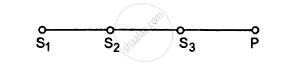
Two coherent narrow slits emitting sound of wavelength λ in the same phase are placed parallel to each other at a small separation of 2λ. The sound is detected by moving a detector on the screen ∑ at a distance D(>>λ) from the slit S1 as shown in figure. Find the distance x such that the intensity at P is equal to the intensity at O.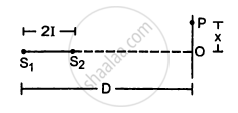
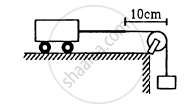
A heavy string is tied at one end to a movable support and to a light thread at the other end as shown in following figure. The thread goes over a fixed pulley and supports a weight to produce a tension. The lowest frequency with which the heavy string resonates is 120 Hz. If the movable support is pushed to the right by 10 cm so that the joint is placed on the pulley, what will be the minimum frequency at which the heavy string can resonate?
The separation between a node and the next antinode in a vibrating air column is 25 cm. If the speed of sound in air is 340 m s−1, find the frequency of vibration of the air column.
A source of sound with adjustable frequency produces 2 beats per second with a tuning fork when its frequency is either 476 Hz of 480 Hz. What is the frequency of the tuning fork?
A tuning fork produces 4 beats per second with another tuning fork of frequency 256 Hz. The first one is now loaded with a little wax and the beat frequency is found to increase to 6 per second. What was the original frequency of the tuning fork?
A train running at 108 km h−1 towards east whistles at a dominant frequency of 500 Hz. Speed of sound in air is 340 m/s. What frequency will a passenger sitting near the open window hear? (b) What frequency will a person standing near the track hear whom the train has just passed? (c) A wind starts blowing towards east at a speed of 36 km h−1. Calculate the frequencies heard by the passenger in the train and by the person standing near the track.
A small speaker delivers 2W of audio output. At what distance from the speaker will one detect 120 dB intensity sound?
[Given reference intensity of sound as 10-12W/m2]
