Advertisements
Advertisements
Question
Explain the process of sewage water treatment before it can be discharged into natural water bodies.
Advertisements
Solution 1
The sewage treatment plants process is carried out in two ways:
- Primary treatment: It involves the physical removal of particles from sewage through filtration and sedimentation. Floating debris is removed by filtration and grit is removed by sedimentation. Thus, all solids which settle from the primary sludge and the supernatant forms the effluent.
- Secondary treatment: The effluent from primary treatment is passed to aeration tanks where the air is pumped into it. This allows the growth of useful aerobic microbes into flocs (masses of bacteria associated with fungal filaments) and microbes consume the major part of the organic matter in the effluent. This reduces the BOD (biological oxygen demand) of the effluent. The effluent is then passed into the settling tank where bacterial flocs are allowed to sediment. This sediment is called activated sludge. The small portion of this activated sludge is again passed to the aeration tank to serve as inocula. The remaining major part of this sludge is pumped into large anaerobic sludge digesters. Here, anaerobic bacteria digest bacteria and fungi in the sludge. During this digestion, bacteria produce a mixture of gases such as methane, H2S, and CO2. This treatment is essential as the sewage or municipal waste discharged into rivers, streams and other water bodies contains human excreta, organic wastes, and several pathogenic microbes.
Solution 2

Before wastewater is made available for human use, it has to be treated properly, so as to remove organic matter, inorganic salts, and pathogens as well.
The sewage treatment process includes four basic steps as follows:
1. Preliminary Treatment: The preliminary treatment includes Screening and Grit Chamber.
a. Screening:
- Sewage and wastewater contain plenty of suspended, floating materials, coarse and solid particles along with dissolved substances.
- The suspended objects are filtered and removed. This is done in screening chambers.
- The sewage is passed through screens or nets in the chambers. Larger suspended or floating objects are held back in the screening chambers.
- These have to be removed before the biological treatment.
b. Grit Chamber:
- After the screening, the filtered sewage is then passed into a series of grit chambers that contain large stones (pebbles) and brick ballast.
- Coarse particles settle down by gravity.
- Thus, the passage of filtered sewage removes much of the coarse particulate matter.
2. Primary treatment (physical treatment):
- After the preliminary treatment, the sewage water is pumped into the primary sedimentation tank.
- The sedimentation of suspended solids or organic matter occurs in this tank.
- About 50-70% of the solids settle down. There is a reduction of about 30-40% (in number) of coliform organisms.
- The organic matter which is settled down is called primary sludge which is removed by mechanically operated devices.
- The supernatant (effluent) in the primary sedimentation tank still contains a large amount of dissolved organic matter and micro-organisms which can then be removed by the secondary treatment.
3. Secondary treatment (biological treatment):
- The primary effluent is passed into large aeration tanks. Here it is constantly agitated mechanically and the air is pumped into it.
- Aerobic bacteria grow vigorously and form flocs.
- Flocs are the masses of bacteria held together by slime and fungal hyphae to form mesh-like masses.
- These aerobic microbes consume the major part of the organic matter present in the effluent, as they grow.
- Due to this BOD (Biochemical Oxygen Demand) of the effluent is significantly reduced.
4. Tertiary treatment:
- Once the BOD of wastewater is reduced, it is passed into a settling tank.
- Here the bacterial flocs are allowed to sediment which is now called activated sludge.
- A small part of this is passed back into the aeration tank and the major part is pumped into large tanks called anaerobic sludge digesters.
- In these tanks, anaerobic bacteria grow and digest the bacteria and fungi in the sludge.
- During this anaerobic digestion, gases such as methane, hydrogen sulphide, CO2, etc. are produced.
- Effluents from these plants (digester) after chlorination are released in natural water bodies like rivers and streams.
- Chlorination kills pathogenic bacteria.
- Digested sludge is then disposed of.
APPEARS IN
RELATED QUESTIONS
Explain the role of microbes in sewage treatment.
Explain the process of secondary treatment given to the primary effluent up to the point it shows significant change in the level of biological oxygen demand (BOD) it.
Distinguish between the roles of flocs and anaerobic sludge digesters in sewage treatments.
What is the key difference between primary and secondary sewage treatment?
Due to which of the following reason/s sewage water cannot be discharged directly into river?
After which of the following process effluents from anaerobic sludge digesters are released in natural water bodies?
In the process of biogas production which of the following anaerobic bacteria are used?
What happens during the course of sewage decomposition?
After which of the following treatment BOD of the effluent is significantly reduced?
In the process of sewage treatment, the activated sludge is digested by ______
The primary treatment of waste water involves the removal of ______.
What would happen if oxygen availability to activated sludge flocs is reduced?
What is the group of bacteria found in both the rumen of cattle and shidge of sewage treatment?
In what way anaerobic sludge digestion is important in sewage treatments?
Study the given diagram of the Sewage Treatment Plant (S.T.P.) and answer the question that follows:
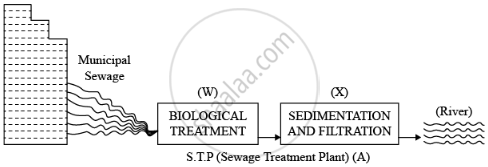
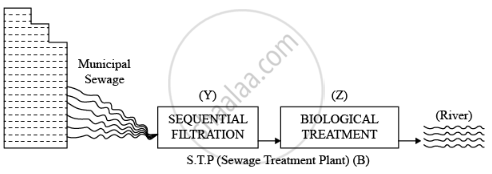
- Which one of the two 'S.T.P.' (A) or (B) will be more effective in treating the human excreta in municipal waste?
- Write the steps followed in carrying the treatment of the sewage in step (Z), once the BOD of sewage is reduced significantly till it is passed on to the "anaerobic sludge digesters".
What is the major component of municipal wastewater (sewage)?
Which mixture of gases is collectively produced as biogas during anaerobic sludge digestion?
Which bacterium is an example of a methanogen commonly found in anaerobic sludge during sewage treatment?
