Advertisements
Advertisements
Question
Study the given diagram of the Sewage Treatment Plant (S.T.P.) and answer the question that follows:
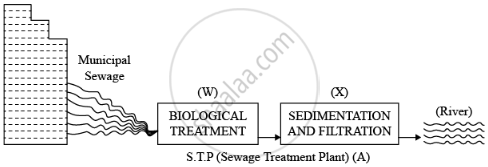
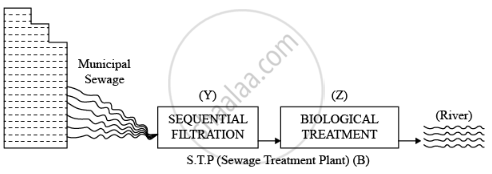
- Which one of the two 'S.T.P.' (A) or (B) will be more effective in treating the human excreta in municipal waste?
- Write the steps followed in carrying the treatment of the sewage in step (Z), once the BOD of sewage is reduced significantly till it is passed on to the "anaerobic sludge digesters".
Advertisements
Solution
- The treatment of human excrement in municipal garbage will be more successful with STP (B). This is so that physical particles from the sewage can be removed in the first STP step by filtering and sedimentation. The biological treatment of the sludge is done in the second STP.
- Once the BOD of sewage or waste water is reduced significantly, the effluent is then passed into a settling tank where the bacterial ‘flocs’ are allowed to sediment. This sediment is called activated sludge. A small part of the activated sludge is pumped back into the aeration tank to serve as the inoculum. The remaining major part of the sludge is pumped into large tanks called anaerobic sludge digesters. Here, other kinds of bacteria, which grow anaerobically, digest the bacteria and the fungi in the sludge. During this digestion, bacteria produce a mixture of gases such as methane, hydrogen sulphide and carbon dioxide. These gases form biogas and can be used as a source of energy as it is inflammable.
APPEARS IN
RELATED QUESTIONS
Explain the different steps involved during primary treatment phase of sewage.
Explain the process of secondary treatment given to the primary effluent up to the point it shows significant change in the level of biological oxygen demand (BOD) it.
Distinguish between the roles of flocs and anaerobic sludge digesters in sewage treatments.
One of the free-living anaerobic nitrogen-fixer is _________.
Why is this sewage water treatment essential?
Into which of the following the sewage water is pumped after preliminary treatment?
During tertiary treatment, the bacterial floes sediment in the sedimentation tank, this sediment is called ____________.
Which of the following is TRUE regarding 'Flocs'?
In what way anaerobic sludge digestion is important in sewage treatments?
What is the major component of municipal wastewater (sewage)?
