Advertisements
Advertisements
प्रश्न
Study the given diagram of the Sewage Treatment Plant (S.T.P.) and answer the question that follows:
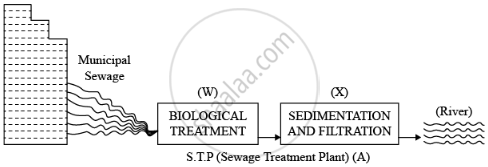
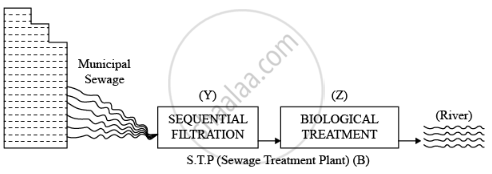
- Which one of the two 'S.T.P.' (A) or (B) will be more effective in treating the human excreta in municipal waste?
- Write the steps followed in carrying the treatment of the sewage in step (Z), once the BOD of sewage is reduced significantly till it is passed on to the "anaerobic sludge digesters".
Advertisements
उत्तर
- The treatment of human excrement in municipal garbage will be more successful with STP (B). This is so that physical particles from the sewage can be removed in the first STP step by filtering and sedimentation. The biological treatment of the sludge is done in the second STP.
- Once the BOD of sewage or waste water is reduced significantly, the effluent is then passed into a settling tank where the bacterial ‘flocs’ are allowed to sediment. This sediment is called activated sludge. A small part of the activated sludge is pumped back into the aeration tank to serve as the inoculum. The remaining major part of the sludge is pumped into large tanks called anaerobic sludge digesters. Here, other kinds of bacteria, which grow anaerobically, digest the bacteria and the fungi in the sludge. During this digestion, bacteria produce a mixture of gases such as methane, hydrogen sulphide and carbon dioxide. These gases form biogas and can be used as a source of energy as it is inflammable.
APPEARS IN
संबंधित प्रश्न
Answer the following question.
Secondary treatment of the sewage is also called Biological treatment. Justify this statement and explain the process.
Removal of large pieces of floating debris, oily substances, etc. during sewage treatment is called _______________.
Small part of activated sludge is passed back into primary sedimentation tank.
If the above statement is correct then rewrite as it is and in case it is incorrect then reframe it.
Small part of activated sludge is passed back into ______ and major part is pumped into large tanks called ______.
Which of the following occurs during secondary treatment?
Study the following statements regarding tertiary treatment of sewage and choose the correct option.
i. It produces methane gas.
ii. The effluents formed from these plants undergo chlorination.
iii. BOD is significantly increased at this step.
iv. It includes screening and passage of effluent through grit chamber.
After which of the following treatment BOD of the effluent is significantly reduced?
Which of the following process is a part of preliminary treatment of sewage?
What would happen if oxygen availability to activated sludge flocs is reduced?
Which one is wrongly matched?
