Advertisements
Advertisements
प्रश्न
What are flocs with respect to sewage treatment?
What are flocs?
Advertisements
उत्तर
Flocs are the masses of bacteria held together by slime and fungal hyphae to form mesh like masses.
संबंधित प्रश्न
Explain the process of sewage water treatment before it can be discharged into natural water bodies.
One of the free-living anaerobic nitrogen-fixer is _________.
Name the tank to which the sewage water is passed after the preliminary treatment?
Small part of activated sludge is passed back into primary sedimentation tank.
If the above statement is correct then rewrite as it is and in case it is incorrect then reframe it.
After which of the following process effluents from anaerobic sludge digesters are released in natural water bodies?
Into which of the following the sewage water is pumped after preliminary treatment?
Identify the INCORRECT statement with respect to sewage treatment.
______ refers to the organic matter which settles down after physical treatment of sewage.
Study the following statements regarding tertiary treatment of sewage and choose the correct option.
i. It produces methane gas.
ii. The effluents formed from these plants undergo chlorination.
iii. BOD is significantly increased at this step.
iv. It includes screening and passage of effluent through grit chamber.
Which of the following is TRUE regarding 'Flocs'?
In the process of sewage treatment, the activated sludge is digested by ______
Which of the following is put into Anaerobic sludge disaster for further sewage treatment?
Methanogenic bacteria are not found in ______.
Wastewater treatment generates a large quantity of sludge, which can be treated by ______.
Why are flocs important in biological treatment of waste water?
In what way anaerobic sludge digestion is important in sewage treatments?
Study the given diagram of the Sewage Treatment Plant (S.T.P.) and answer the question that follows:
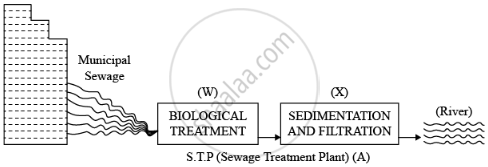
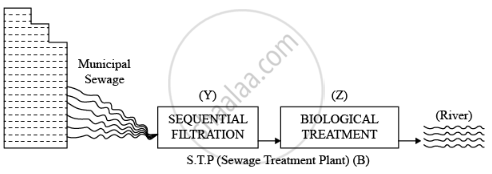
- Which one of the two 'S.T.P.' (A) or (B) will be more effective in treating the human excreta in municipal waste?
- Write the steps followed in carrying the treatment of the sewage in step (Z), once the BOD of sewage is reduced significantly till it is passed on to the "anaerobic sludge digesters".
What is the major component of municipal wastewater (sewage)?
What are 'flocs' in the context of biological wastewater treatment?
