Advertisements
Advertisements
प्रश्न
Wastewater treatment generates a large quantity of sludge, which can be treated by ______.
पर्याय
anaerobic digesters
floc
chemicals
oxidation pond
Advertisements
उत्तर
Wastewater treatment generates a large quantity of sludge, which can be treated by anaerobic digesters.
Explanation:
During wastewater treatment, the solid part that settles at the bottom is called sludge. This sludge is treated in anaerobic digesters, where microorganisms break down organic matter in the absence of oxygen, producing biogas (mainly methane) and reducing the volume of waste.
APPEARS IN
संबंधित प्रश्न
Explain the function of “anaerobic sludge digester” in a sewage treatment plant.
Distinguish between the roles of flocs and anaerobic sludge digesters in sewage treatments.
Explain the process of sewage water treatment before it can be discharged into natural water bodies.
Answer the following question.
What are ‘flocs’, formed during secondary treatment of sewage?
What are flocs with respect to sewage treatment?
Due to which of the following reason/s sewage water cannot be discharged directly into river?
Which of the following is TRUE about primary treatment?
In the process of biogas production which of the following anaerobic bacteria are used?
Which of the following occurs during secondary treatment?
Into which of the following the sewage water is pumped after preliminary treatment?
Identify the type of microorganisms involved in floe formation during sewage treatment.
Identify the INCORRECT statement with respect to sewage treatment.
What happens during the course of sewage decomposition?
During tertiary treatment, the bacterial floes sediment in the sedimentation tank, this sediment is called ____________.
Which of the following is TRUE regarding 'Flocs'?
In the process of sewage treatment, the activated sludge is digested by ______
Which of the following is put into Anaerobic sludge disaster for further sewage treatment?
Methanogenic bacteria are not found in ______.
Why do we prefer to call secondary waste water treatment as biological treatment?
Study the given diagram of the Sewage Treatment Plant (S.T.P.) and answer the question that follows:
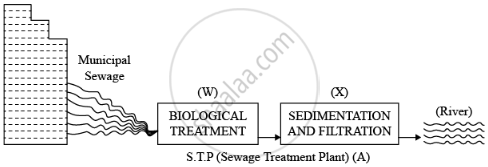
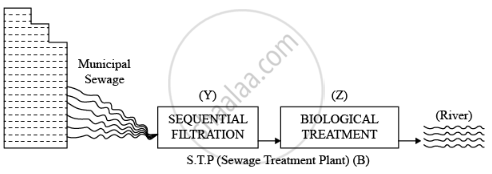
- Which one of the two 'S.T.P.' (A) or (B) will be more effective in treating the human excreta in municipal waste?
- Write the steps followed in carrying the treatment of the sewage in step (Z), once the BOD of sewage is reduced significantly till it is passed on to the "anaerobic sludge digesters".
Which of the following statement is correct for Sewage Treatment Plants (STPs)?
What are 'flocs' in the context of biological wastewater treatment?
Which mixture of gases is collectively produced as biogas during anaerobic sludge digestion?
By what percentage does the decomposition of organic matter by aerobic bacteria in aeration tanks typically lower the BOD during secondary treatment?
