Advertisements
Advertisements
प्रश्न
Explain the role of microbes in sewage treatment.
Advertisements
उत्तर
Microbes play a significant role during secondary and tertiary sewage treatment.
- During secondary treatment, primary effluent is continuously agitated in a large tank due to which vigorous growth of useful aerobic microbes into flocs takes place. These microbes consume major part of the organic matter in the effluent as they grow. Due to this, BOD of the effluent is significantly reduced.
- During tertiary treatment, bacterial flocs are allowed to sediment. Small part of it is passed back into the aeration tank and a large part is pumped into large tanks called anaerobic sludge digesters. These anaerobic bacteria digest the bacteria and fungi in sludge.
- Thus, use of microbes in sewage treatment helps to remove organic matter from waste water before it is discharged in water bodies like rivers.
APPEARS IN
संबंधित प्रश्न
Distinguish between the roles of flocs and anaerobic sludge digesters in sewage treatments.
Explain the process of sewage water treatment before it can be discharged into natural water bodies.
Answer the following question.
Secondary treatment of the sewage is also called Biological treatment. Justify this statement and explain the process.
Name the tank to which the sewage water is passed after the preliminary treatment?
The purpose of biological treatment of waste water is to ______.
Which of the following occurs during tertiary treatment?
During sewage, treatment biogas is produced wits which include:
Which of the following is put into Anaerobic sludge disaster for further sewage treatment?
In which of the following step large and small particles are removed from sewage through sequential filtration and sedimentation?
Study the given diagram of the Sewage Treatment Plant (S.T.P.) and answer the question that follows:
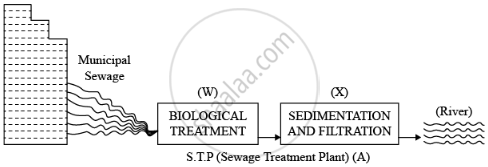
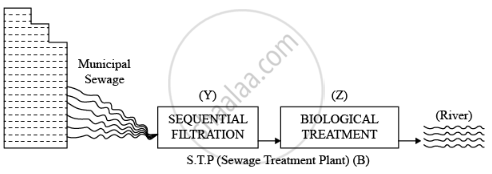
- Which one of the two 'S.T.P.' (A) or (B) will be more effective in treating the human excreta in municipal waste?
- Write the steps followed in carrying the treatment of the sewage in step (Z), once the BOD of sewage is reduced significantly till it is passed on to the "anaerobic sludge digesters".
