Advertisements
Advertisements
Question
Why is aerobic degradation more important than anaerobic degradation for the treatment of large volumes of waste waters rich in organic matter. Discuss.
Advertisements
Solution
Organic matter in wastewater consumes a lot of oxygen to carry on various biological processes. It results in reduction of oxygen level. In the surrounding air and thus can Increase air pollution. Consumption of oxygen by organic matter in wastewater is measured by BOD (Biochemical Oxygen Demand). A higher level of BOD indicates a higher polluting potential of wastewater. It is important to reduce the BOD so that pollution can be reduced. Hence, aerobic degradation is more important than anaerobic degradation for the treatment of large volumes of wastewaters rich in organic matter. BOD level is reduced by aerobic degradation which is carried out by floc. Flocs are associations of bacteria and fungi which form mesh-like structures. Flocs eat away most of the organic matter in wastewater and thus help in reducing BOD. Once BOD Is pulled down below a threshold level the sludge is ready for anaerobic degradation.
APPEARS IN
RELATED QUESTIONS
Explain the different steps involved during primary treatment phase of sewage.
Explain the process of secondary treatment given to the primary effluent up to the point it shows significant change in the level of biological oxygen demand (BOD) it.
Three water samples namely river water, untreated sewage water and secondary effluent discharged from a sewage treatment plant were subjected to BOD test. The samples were labelled A, B and C; but the laboratory attendant did not note which was which. The BOD values of the three samples A, B and C were recorded as 20 mg/L, 8 mg/L and 400 mg/L, respectively. Which sample of the water is most polluted? Can you assign the correct label to each, assuming the river water is relatively clean?
Answer the following question.
What are 'flocs', formed during secondary treatment of sewage?
Answer the following question.
Secondary treatment of the sewage is also called Biological treatment. Justify this statement and explain the process.
Removal of large pieces of floating debris, oily substances, etc. during sewage treatment is called _______________.
Why is this sewage water treatment essential?
Which of the following is TRUE about primary treatment?
Nitrogen fixation by organisms requires conditions that are:
Methanogenic bacteria are not found in ______.
In a sewage treatment plant, all of the following processes belong to secondary treatment except:
Wastewater treatment generates a large quantity of sludge, which can be treated by ______.
The primary treatment of waste water involves the removal of ______.
Study the given diagram of the Sewage Treatment Plant (S.T.P.) and answer the question that follows:
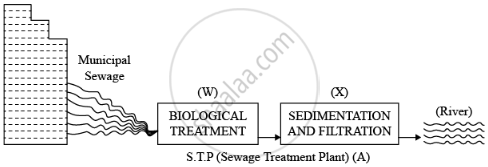
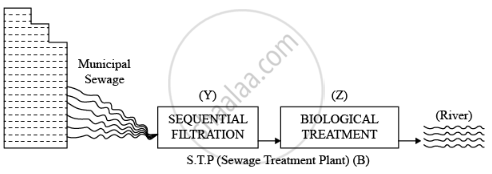
- Which one of the two 'S.T.P.' (A) or (B) will be more effective in treating the human excreta in municipal waste?
- Write the steps followed in carrying the treatment of the sewage in step (Z), once the BOD of sewage is reduced significantly till it is passed on to the "anaerobic sludge digesters".
Which of the following statement is correct for Sewage Treatment Plants (STPs)?
Biochemical Oxygen Demand (BOD) serves as an indirect measure of which water quality parameter?
Which action plans were initiated by the Ministry of Environment and Forests to construct sewage treatment plants and protect major Indian rivers from pollution?
