Advertisements
Advertisements
Question
Three water samples namely river water, untreated sewage water and secondary effluent discharged from a sewage treatment plant were subjected to BOD test. The samples were labelled A, B and C; but the laboratory attendant did not note which was which. The BOD values of the three samples A, B and C were recorded as 20 mg/L, 8 mg/L and 400 mg/L, respectively. Which sample of the water is most polluted? Can you assign the correct label to each, assuming the river water is relatively clean?
Advertisements
Solution
Biological oxygen demand (BOD) is the method of determining the amount of oxygen required by micro-organisms to decompose the waste present in the water supply. If the quantity of organic waste in the water supply is high, then the number of decomposing bacteria present in the water will also be high. As a result, the BOD value will increase.
Therefore, it can be concluded that if the water supply is more polluted, then it will have a higher BOD value. Out of the above three samples, sample C is the most polluted since it has the maximum BOD value of 400 mg/L. After untreated sewage water, secondary effluent discharge from a sewage treatment plant is most polluted. Thus, sample A is secondary effluent discharge from a sewage treatment plant and has the BOD value of 20 mg/L, while sample B is river water and has the BOD value of 8 mg/L.
Hence, the correct label for each sample is:
| Label | BOD value | Sample |
| A | 20 mg/L | Secondary effluent discharge from a sewage treatment plant |
| B | 8 mg/L | River water |
| C | 400 mg/L | Untreated sewage water |
APPEARS IN
RELATED QUESTIONS
Explain the function of “anaerobic sludge digester” in a sewage treatment plant.
Describe how do 'flocs' and 'activated sludge' help in Sewage Treatment.
Why is this sewage water treatment essential?
Name the chamber in which the suspended objects are filtered and removed during sewage treatment?
Name the tank to which the sewage water is passed after the preliminary treatment?
Due to which of the following reason/s sewage water cannot be discharged directly into river?
Which of the following is TRUE about primary treatment?
Small part of activated sludge is passed back into ______ and major part is pumped into large tanks called ______.
Into which of the following the sewage water is pumped after preliminary treatment?
Identify the INCORRECT statement with respect to sewage treatment.
What happens during the course of sewage decomposition?
During tertiary treatment, the bacterial floes sediment in the sedimentation tank, this sediment is called ____________.
Study the following statements regarding tertiary treatment of sewage and choose the correct option.
i. It produces methane gas.
ii. The effluents formed from these plants undergo chlorination.
iii. BOD is significantly increased at this step.
iv. It includes screening and passage of effluent through grit chamber.
Nitrogen fixation by organisms requires conditions that are:
Activated sludge should have the ability to settle quickly so that it can ______.
Why do we prefer to call secondary waste water treatment as biological treatment?
What is the group of bacteria found in both the rumen of cattle and shidge of sewage treatment?
Why are flocs important in biological treatment of waste water?
Why is aerobic degradation more important than anaerobic degradation for the treatment of large volumes of waste waters rich in organic matter. Discuss.
Ganga has recently been declared the national river. Discuss the implication with respect to pollution of this river.
What would happen if a large volume of untreated sewage is discharged into a river?
Study the given diagram of the Sewage Treatment Plant (S.T.P.) and answer the question that follows:
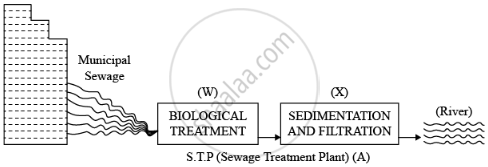
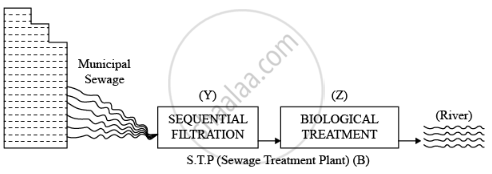
- Which one of the two 'S.T.P.' (A) or (B) will be more effective in treating the human excreta in municipal waste?
- Write the steps followed in carrying the treatment of the sewage in step (Z), once the BOD of sewage is reduced significantly till it is passed on to the "anaerobic sludge digesters".
After a significant reduction in the BOD of wastewater, it is passed into a settling tank where bacterial flocs are allowed to sediment. This sediment is called ______.
In a sewage treatment plant, grit comprising soil and small pebbles is removed during which stage and process?
What happens to the polluting potential of wastewater as its Biochemical Oxygen Demand (BOD) increases?
Which bacterium is an example of a methanogen commonly found in anaerobic sludge during sewage treatment?
Which action plans were initiated by the Ministry of Environment and Forests to construct sewage treatment plants and protect major Indian rivers from pollution?
By what percentage does the decomposition of organic matter by aerobic bacteria in aeration tanks typically lower the BOD during secondary treatment?
