Advertisements
Advertisements
Question
Explain sexual reproduction in plants.
Advertisements
Solution

- In sexually reproducing plants, flowers function as the reproductive organs.
- In flowers, male organ is the stamen and female organ is the carpel.
- Flowers which have both the male and female organs i.e. stamens and carpels are called bisexual flowers whereas flowers which have either male or female organs are called unisexual.
- Male gametes called pollen grains are produced by stamen, and carpels produce female gametes called ovules or egg cells inside ovaries.
- Fertilization takes place in the ovule where the egg cell and pollen grain fuse.
- This fertilized egg cell later develops into an embryo and the entire ovule gets converted into a seed.
- Under favourable conditions, the seed germinates to give rise to a new plant.
APPEARS IN
RELATED QUESTIONS

(i) Name the part marked 'A' in the diagram.
(ii) How dose 'A' reachese part 'B'?
(iii) State the importance of the part 'C'.
(iv) What happens to the part marked 'D' after fertilisation is over?
"The chromosomal number of the sexually producing parents and their offspring is the same." Justify this statement.
Sketch the reproductive parts of a flower.
How does the process of fertilisation take place in flowers?
Name the swollen lower part of the carpel.
Where are the pollen grains produced?
Where are a plant's sex organs located?
What is the name of female part of a flower?
Fill in the following blank with suitable word :
The ovary of a flower becomes ....... after fertilisation.
Fill in the following blank with suitable word :
The female organ of reproduction in the flower is the...........
What is made in anther of a flower?
How do the insects help in cross-pollination?
What type of plants reproduce by sexual reproduction method?
What is pollination? How does pollination occur?
Which of the following is the correct sequence of events of sexual reproduction in a flower?
(a) pollination, fertilisation, seed, embryo
(b) seed, embryo, fertilisation, pollination
(c) pollination, fertilisation, embryo, seed
(d) embryo, seed, pollination, fertilisation
The part of a seed which grows and develops into root on germination is :
(a) cotyledon
(b) plumule
(c) follicle
(d) radicle
Fill in the blanks:
A carpel consists of ________ , ________ and ________.
Fill in the blanks:
A stamen consists of ______ and ________.
State whether the following statement is true (T) or false (F):
Flowers which possess stamens and carpel are called unisexual.
What part is played by stamens and carpels in reproduction?
Draw a diagram of the longitudinal section of a flower exhibiting germination of pollen on stigma and label (i) ovary, (ii) male germ-cell, (iii) female germ-cell and (iv) ovule on it.
Identify A, B, C and D in the given diagram and write their names.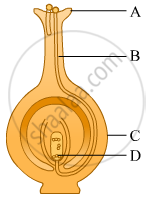
“Cell division is a type of reproduction in unicellular organism.” Justify.
Mention pollination types.
A student is observing the temporary mount of a leaf peel under a microscope. Draw a labelled diagram of the structure of stomata as seen under the microscope
What is cleistogamy? Write one advantage and one disadvantage of it, to the plant.
__________ is present in unisexual flower.
Write the functions of sepals
Draw a neat and labelled diagram.
Double fertilization in angiosperms
Match the following
| 1. | Petal | Opuntia |
| 2. | Fern | Chrysanthemum |
| 3. | Phylloclade | Attracts insect |
| 4. | Hooks | Spore |
| 5. | Sucker | Bignonia |
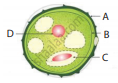
Identify the parts A, B, C, and D?
In which of the following manner the arrangement of megaspores in a tetrad is observed in angiosperms?
What would be the number of chromosomes of the aleurone cells of a plant with 42 chromosomes in its roots tip cells?
Gloriosa superba exhibits ______.
Flowers showing ornithophily show few characteristic like ______.
In a bisexual flower inspite of the young stamens being removed artificially, the flower produces fruit. Provide a suitable explanation for the above situation.
