Advertisements
Advertisements
Question
Explain replication of bacteriophage with the help of a suitable diagram.
Advertisements
Solution
the following steps:
- Attachment: Bacteriophages attach to specific receptors on the surface of bacteria. As
phages do not move independently, they rely on random encounters with the right
receptors. - Penetration: After attachment, the tail fibres bring the base plate closer to the surface
of the cell. Once attached completely, the tail contracts, injecting genetic material
(DNA) through the bacterial membrane. (Capsid – protein coat remains outside and is
called ‘ghost’)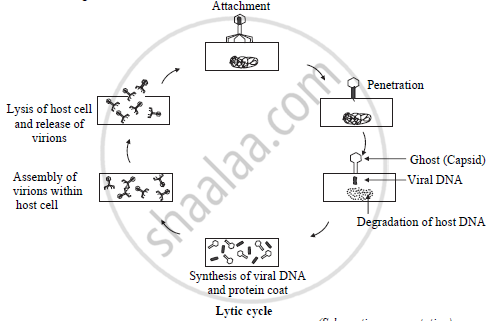
- Degradation of host DNA: Once the viral DNA enters the host cell, the degradation of
host DNA starts. - Synthesis of proteins and nucleic acid: The host’s normal synthesis of proteins and
nucleic acids is disrupted, and it is forced to manufacture viral DNA and proteins
instead. These products are the parts of new virions within the cell or proteins involved
in cell lysis. - Virion assembly: The base plates are assembled with the tails first. The head (capsids)
are constructed separately and then are joined with the tails. The DNA is packed
efficiently within the head. The whole process takes about 15 minutes. - Release of virions: Phages are released via. lysis of cell. It is achieved by an enzyme
called endolysin, which breaks down the cell wall. Released virions are capable of
infecting a new bacterium.
APPEARS IN
RELATED QUESTIONS
What is the correct sequence of the stages in bacteriophage lytic cycle?
(A) Attachment, Penetration, Lysis, Multiplication
(B) Attachment, Penetration, Multiplication, Lysis
(C) Lysis, Penetration, Multiplication, Attachment
(D) Attachment, Lysis, Multiplication, Penetration
What is the function of an RNA primer during protein synthesis?
What is the function of SSBP?
For which of the following purpose agarose gel electrophoresis technique is used?
During DNA replication, Okazaki fragments are used to elongate ____________.
Identify the biomolecule that is capable of self-replication.
The sequence of nitrogenous bases on DNA molecule is ATCGA. Which of the following is the correct complementary sequence of nitrogenous bases on mRNA molecule?
Which of the following statement is correct regarding the process of replication in E.coli?
According to the conservative model of DNA replication, the original DNA double strand would:
In the dispersive model of DNA replication, both strands of both daughter DNA molecules would consist of:
