Advertisements
Advertisements
प्रश्न
Explain replication of bacteriophage with the help of a suitable diagram.
Advertisements
उत्तर
the following steps:
- Attachment: Bacteriophages attach to specific receptors on the surface of bacteria. As
phages do not move independently, they rely on random encounters with the right
receptors. - Penetration: After attachment, the tail fibres bring the base plate closer to the surface
of the cell. Once attached completely, the tail contracts, injecting genetic material
(DNA) through the bacterial membrane. (Capsid – protein coat remains outside and is
called ‘ghost’)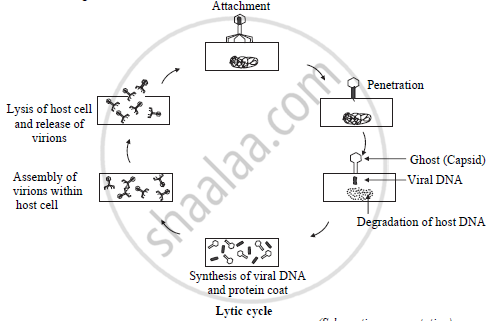
- Degradation of host DNA: Once the viral DNA enters the host cell, the degradation of
host DNA starts. - Synthesis of proteins and nucleic acid: The host’s normal synthesis of proteins and
nucleic acids is disrupted, and it is forced to manufacture viral DNA and proteins
instead. These products are the parts of new virions within the cell or proteins involved
in cell lysis. - Virion assembly: The base plates are assembled with the tails first. The head (capsids)
are constructed separately and then are joined with the tails. The DNA is packed
efficiently within the head. The whole process takes about 15 minutes. - Release of virions: Phages are released via. lysis of cell. It is achieved by an enzyme
called endolysin, which breaks down the cell wall. Released virions are capable of
infecting a new bacterium.
APPEARS IN
संबंधित प्रश्न
Semiconservative mechanism of DNA was detected using:
From their examination of the structure of DNA, What did Watson and Crick infer about the probable mechanism of DNA replication, coding capability, and mutation?
Meselson and Stahl used ____________ in the experiment to prove semiconservative DNA replication.
Assertion (A): DNA replication is said to be semi-conservative.
Reason (R): After DNA replication, each daughter molecule has one old and one new strand.
Which of the following statement is incorrect?
Wobble position means:
Okazaki is known for his contribution to the under tanding of:
During replication of DNA Okazaki fragments are formed in the direction:
In the experiment of Meselson and Stahl, the heavy DNA was separated from light DNA by centrifugation in ______.
The sequence of nitrogenous bases on DNA molecule is ATCGA. Which of the following is the correct complementary sequence of nitrogenous bases on mRNA molecule?
