Advertisements
Advertisements
Question
Explain free and forced vibrations. Give an experimental arrangement to illustrate the phenomenon of resonance.
Advertisements
Solution
When a system or a body vibrates without receiving impulses from another system or body, its vibrations are said to be free vibrations. However, when a system or body vibrates on account of impulses received from another system or body, the vibrations are called forced vibrations. In such a case the body or the system vibrates with the frequency of the impulses received and not with its natural frequency.
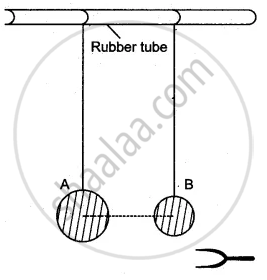
Experiment Arrangement to illustrate Resonance: In the figure, the two pendulums have exactly equal lengths. However, the bob of the pendulum A is heavier. Displace the bob of the pendulum A by a little distance in a direction perpendicular to the plane containing the two pendulums. Then release the bob. The pendulum A will begin to oscillate. After a short while, you will find that the pendulum B also begins to vibrate. Note that the two pendulums have the same frequency. The pendulum A through the rubber tube applies impulses of the same frequency on the pendulum B Hence, the pendulum B begins to vibrate.
RELATED QUESTIONS
Name the phenomenon involved in tunning a radio set to a particular station
What are mechanical waves?
The adjacent diagram shows three different modes of vibrations P, Q and R of the same string.
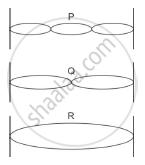
(i) Which vibration will produce a louder sound and why?
(ii) The sound of which string will have maximum shrillness?
(iii) State the ratio of wavelengths of P and R.
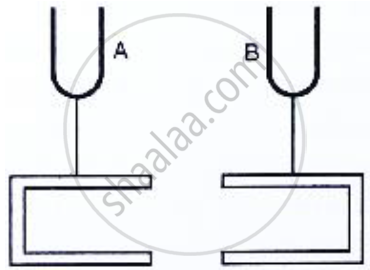
In following figure shows two tuning forks A and B of the same frequency mounted on two separate sound boxes with their open ends facing each other. The fork A is set into vibration.
- Describe your observation.
- State the principle illustrated by this experiment.
A tuning fork of frequency 256 Hz will resonate with another tuning fork of frequency:
Two pendulums C and D are suspended from a wire as shown in the figure give below. Pendulum C is made to oscullate by displaying it from its mean position. It is seen that D also starts oscillating.
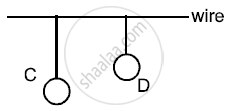
(i) Name the type of oscillation, C will execute.
(ii) Name the type of oscillation, D will execute.
(iii) If the length of D is made equal to C then what difference will you notice in the oscillations of D ?
(iv) What is the name of the phenomenon when the length of D is made equal to C ?
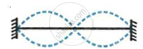
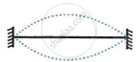
The diagram below shows three different modes of vibration P, Q and R of the same string of a given length.
 |
 |
 |
| P | Q | R |
- Which vibration will produce a louder sound and why?
- Which vibration will produce sound of maximum shrillness (or pitch) and why?
- What is the ratio of wavelength of vibrations P and R?
Explain a tuning fork (vibrating) is held close to ear. One hears a faint sound. The same vibrating tuning fork is placed on table, such that its handle is in contact with table, one hears a loud sound.
A vibrating tuning fork is placed over the mouth of a burette filled with water. The tap is opened and the water level gradually falls. It is observed that the sound becomes the loudest for a particular length of the air column. What is the name of the phenomenon taking place when this happens? Why does the sound become the loudest?
Explain a person walking past a railway line, in the middle of night hears a ringing sound along with the sound of his footsteps.
