Advertisements
Advertisements
Question
Draw the structure of the following atoms showing the nucleus containing – protons, neutrons and the orbits with the respective electron:
Isotopes of hydrogen [11H, 21H, 31H]
Advertisements
Solution
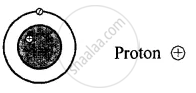
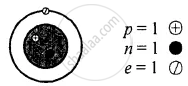
Structure of atoms:
\[\ce{^2_1H}\]
\[\ce{^3_1H}\]
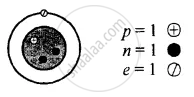
Z is Atomic Number and A is the mass number
Isotopes of hydrogen \[\ce{^1_1H}\]
Z = 1 = p = e
∴ e = 1
A = p + n
1 = 1 + n
∴ n = 1 − 1 = 0
APPEARS IN
RELATED QUESTIONS
In Milikan’s experiment, static electric charge on the oil drops has been obtained by shining X-rays. If the static electric charge on the oil drop is - 1.282 × 10⁻¹⁸C, calculate the number of electrons present on it.
Fill in the blank
An ion which has a positive charge is called a ..................
Fill in the following blanks in respect of an atom of an element
| No. of protons | No. of neutron | Mass number | Atomic number | No. of electrons | Symbol |
| 11 | 12 | ___________ | ___________ | ___________ | ________ |
Sulphur has an atomic number 16 and a mass of 32.
State the number of protons and neutrons in the nucleus of sulphur. Give a simple diagram to show the arrangement of electrons in an atom of sulphur.
Draw the atomic diagram of the following element showing the distribution of – protons, neutrons and the electrons in the various shell of the atom.
Carbon – \[\ce{^12_6C}\]
[The upper number represent the – mass number and the lower number represent the – atomic number e.g. calcium – mass number = 40, atomic number = 20]
Match the statements in List I with the correct answer from List II.
| List I | List II |
| 1. Mass number of an atom is the number of protons and | A: Electron |
| 2. The sub-atomic particle with a negligible mass. | B: Argon |
| 3. An atom having stable electronic configuration. | C: Nitrogen |
| 4. A molecule formed by sharing of electrons [covalency] | D: Sodium |
| 5. A metallic atom having unstable electronic configuration. | E: Neutrons |
Atomic number : ______ :: Mass number : Number of protons and neutrons.
If M is the atomic mass and A is the mass number, then packing fraction is given by ______.
Element ‘P' has electronic configuration 2,8,8,1. The number of chlorine atoms present in the chloride of ‘P’ is ______.
A group of elements in the periodic table is given below (Boron is the first member of the group and Thallium is the last).
Boron, Aluminium, Gallium, Indium, Thallium
Answer the following question in relation to the above group of elements:
The atomic number of boron is 5. Write the chemical formula of the compound formed when boron reacts with chlorine.
