Advertisements
Advertisements
Question
Draw isomers of the following.
\[\ce{Pt(NH3)2ClNO2}\]
Advertisements
Solution
Cis and trans isomers of \[\ce{Pt(NH3)2ClNO2}\]
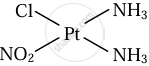 |
 |
| Cis isomer | Trans isomer |
APPEARS IN
RELATED QUESTIONS
Give one chemical test as an evidence to show that [Co (NH3)5Cl] are ionisation isomers.
Answer the following in one or two sentences.
Predict whether the [Cr(en)2(H2O)2]3+ complex is chiral. Write the structure of its enantiomer.
Answer the following question.
Draw isomers of the following
Ru(NH3)4Cl2
The pair [Co(NH3)5(SO4)]Br and [Co(NH3)5Br]SO4 exhibits ____________ isomerism
Write the type of isomerism exhibited by [Co(NH3)5(NO2)]2+ and [Co(NH3)5ONO]2+ pair of complex ion.
Define the term Co-ordination isomer.
Draw the geometrical isomers of the following complexes [Pt(NH3)(H2O)Cl2].
Which one of the following complexes is not expected to exhibit isomerism?
Fac-mer isomerism is shown by
Which of the following is NOT a pair of structural isomers?
The number of geometrical isomers of [CrCl2(en)2]+ is ____________.
Which of the following is NOT an isomer of n-hexane?
Which of the following does NOT show optical isomerism?
The complex ions [Co(H2O)5(ONO)]2+ and [Co(H2O)5NO2]2+ are ____________.
What type of isomerism is present between (I) [Cr(H2O)6]Cl3 and (II) [Cr(H2O)5Cl]Cl2.H2O?
\[\ce{IUPAC}\] name of \[\ce{[Pt(NH3)2 Cl(NO2)]}\] is ______.
Assertion: Complexes of MX6 and MX5L type (X and L are unidentate) do not show geometrical isomerism.
Reason: Geometrical isomerism is not shown by complexes of coordination number 6.
The relationship between compound (i) and (ii) is
 |
 |
| (i) | (ii) |
The correct structure of Fe(CO)5 is
Which of the following compounds show optical isomerism?
The number of geometrical isomers of \[\ce{[Co(NH3)3 (NO3)3]}\] are ______.
The one that is not expected to show isomerism is ______.
Indicate the types of isomerism exhibited by the following complexes and draw the structures for these isomers: [Pt(NH3)(H2O)Cl2]
Draw the structure of cis isomers of Pt(NH3)2Cl2.
Draw the structure of trans isomers of Pt(NH3)2Cl2.
Which one of the following complex ions has geometrical isomers?
Three organic compounds A, B and C are non cyclic functional isomers of carbonyl compounds with molecular formula C4H8O. Isomers A and C give positive Tollen’s test while compound B does not give positive Tollen’s test but gives positive iodoform test. Compounds A and B on reduction with Zn amalgam and conc. HCl give the same product.
- Write the structures of the compounds A, B and C.
- Out of the compounds A, B and C, which one will be the least reactive towards addition of HCN.
