Advertisements
Advertisements
Question
Indicate the complex ion which shows geometrical isomerism.
Options
\[\ce{[Cr(H2O)4Cl2]^+}\]
\[\ce{[Pt(NH3)3Cl]}\]
\[\ce{[Co(NH3)6]^{3+}}\]
\[\ce{[Co(CN)5(NC)]^{3-}}\]
Advertisements
Solution
\[\ce{[Cr(H2O)4Cl2]^+}\]
Explanation:
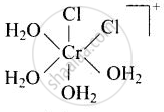
cis-isomer
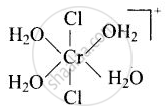
trans-isomer
APPEARS IN
RELATED QUESTIONS
Answer the following in one or two sentences.
Consider the complexes \[\ce{[Cu(NH3)4][PtCl4] and [Pt(NH3)4] [CuCl4]}\]. What type of isomerism these two complexes exhibit?
Draw isomers of the following.
\[\ce{Pt(NH3)2ClNO2}\]
Answer the following question.
Draw isomers of the following
[Cr(en2)Br2]⊕
The pair [Co(NH3)5(SO4)]Br and [Co(NH3)5Br]SO4 exhibits ____________ isomerism
Draw optical isomers of [Co(en)3]3+.
Which type of isomerism is exhibited by [Pt(NH3)2Cl2]?
How many geometrical isomers are possible for \[\ce{[Pt(Py)(NH3)(Br)(Cl)]}\]?
Which one of the following pairs represents linkage isomers?
What is linkage isomerism? Explain with an example.
Which of the following is NOT a pair of structural isomers?
Identify the CORRECT statement about the following complex of platinum.
[PtCl2(en)2]2+
The number of geometrical isomers of [CrCl2(en)2]+ is ____________.
Consider the two complexes given below:
\[\ce{\underset{(I)}{[Co(NH3)5SO4]Br}}\] and \[\ce{\underset{(II)}{[Co(NH3)5Br]SO4}}\]
I and II are ____________ isomers.
\[\ce{IUPAC}\] name of \[\ce{[Pt(NH3)2 Cl(NO2)]}\] is ______.
Assertion: Complexes of MX6 and MX5L type (X and L are unidentate) do not show geometrical isomerism.
Reason: Geometrical isomerism is not shown by complexes of coordination number 6.
The correct structure of Fe(CO)5 is
Define Distereoisomers.
Give trans isomer of [Co(NH3)4Cl2]⊕.
Explain the geometrical isomerism of the octahedral complex of the type [M(AA)2B2]n± with a suitable example.
The co-ordination number of Co3+ ion in the complex [Co(NH3)4Cl2]⊕ is ______.
