Advertisements
Advertisements
प्रश्न
Indicate the complex ion which shows geometrical isomerism.
विकल्प
\[\ce{[Cr(H2O)4Cl2]^+}\]
\[\ce{[Pt(NH3)3Cl]}\]
\[\ce{[Co(NH3)6]^{3+}}\]
\[\ce{[Co(CN)5(NC)]^{3-}}\]
Advertisements
उत्तर
\[\ce{[Cr(H2O)4Cl2]^+}\]
Explanation:
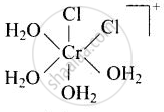
cis-isomer
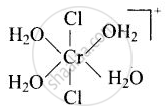
trans-isomer
APPEARS IN
संबंधित प्रश्न
Out of  and
and  , which one is optically active and why ?
Answer the following in one or two sentences.
Consider the complexes \[\ce{[Cu(NH3)4][PtCl4] and [Pt(NH3)4] [CuCl4]}\]. What type of isomerism these two complexes exhibit?
Answer the following question.
Draw isomers of the following
[Cr(en2)Br2]⊕
The pair [Co(NH3)5(SO4)]Br and [Co(NH3)5Br]SO4 exhibits ____________ isomerism
Define the term Co-ordination isomer.
Which one of the following pairs represents linkage isomers?
What are hydrate isomers? Explain with an example.
Which of the following is NOT a pair of structural isomers?
How many isomers are possible for an alkane having molecular formula C5H12?
The number of geometrical isomers of [CrCl2(en)2]+ is ____________.
Consider the two complexes given below:
\[\ce{\underset{(I)}{[Co(NH3)5SO4]Br}}\] and \[\ce{\underset{(II)}{[Co(NH3)5Br]SO4}}\]
I and II are ____________ isomers.
The formula of two complexes X and Y of chromium are given below:
\[\ce{\underset{(X)}{[Cr(H2O)6]Cl3}}\] and \[\ce{\underset{(Y)}{[Cr(H2O)5Cl]Cl2.H2O}}\]
X and Y are examples of ____________ isomers.
How many donor groups are present in diethylene triamine?
Which of the following does not show optical isomerism?
Which of the following compounds show optical isomerism?
Which of the following shows maximum number of isomers?
Explain the geometrical isomerism of the octahedral complex of the type [M(AA)2B2]n± with a suitable example.
Explain the ionisation isomers.
Name the type of isomerism exhibited by the following pair of compounds:
[Cr(H2O)5Cl]Cl2.H2O and [Cr(H2O)4Cl2]Cl.2H2O
