Advertisements
Advertisements
Question
Distinguish between the three states of matter—solid, liquid, and gas on the basis of their molecular models
Advertisements
Solution
Solids:
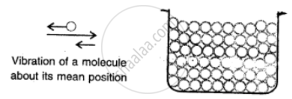
Here the molecules are very tighty packed that there is no or very less inteimolecular space and there is high intermolecular force of attraction (force of cohesion).
The molecules do not move about their mean position and thus solids have a definite shape and volume.
Liquids:
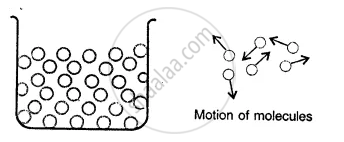
Here the molecules are less tightly packed as compared to solids and also there is lesser force of intermolecular attraction. The intermolecular distance is greater than that in the solids. Thus, they donot have a definite shape but acquire the shape of the vessel in which they are contained but have a definite volume at a given temperature.
Gases:
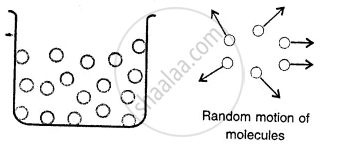
Here the molecules are far apart from each other i.e. have the greatest intermolecular distance which result into the weakest intermolecular forces of attraction. The molecules as are not bound by any strong force move about freely and thus gases do not have a definite shape and also do not have any definite volume.
APPEARS IN
RELATED QUESTIONS
Water evaporates only at 100°C.
State three properties of molecules of a matter.
Write true or false for the following statement
The liquids are less viscous than the gases.
Fill in the blank
A solid exerts pressure .....................
A gas has neither a definite volume nor a definite shape. Describe the molecular model to explain it.
What do you mean by the change of state of matter?
Give a reason for the Liquids can flow easily.
Fill in the blank
The temperature at which a liquid boils is called the ................. point of that liquid.
Fill in the blank with the correct word Given below.
From the three states of matter, _____ expand the least.
Fill in the blank with the correct word Given below.
Matter can change from one state to another by the change in ____
