Advertisements
Advertisements
प्रश्न
Distinguish between the three states of matter—solid, liquid, and gas on the basis of their molecular models
Advertisements
उत्तर
Solids:
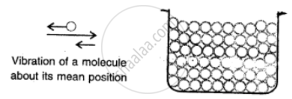
Here the molecules are very tighty packed that there is no or very less inteimolecular space and there is high intermolecular force of attraction (force of cohesion).
The molecules do not move about their mean position and thus solids have a definite shape and volume.
Liquids:
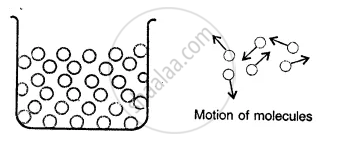
Here the molecules are less tightly packed as compared to solids and also there is lesser force of intermolecular attraction. The intermolecular distance is greater than that in the solids. Thus, they donot have a definite shape but acquire the shape of the vessel in which they are contained but have a definite volume at a given temperature.
Gases:
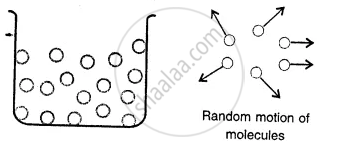
Here the molecules are far apart from each other i.e. have the greatest intermolecular distance which result into the weakest intermolecular forces of attraction. The molecules as are not bound by any strong force move about freely and thus gases do not have a definite shape and also do not have any definite volume.
APPEARS IN
संबंधित प्रश्न
Fill in the blank
The gases are .......... dense.
Distinguish between solids, liquids, and gases on the basis of their following properties :
(a) compressibility
(b) fluidity
(c) rigidity
(d) expansion on heating
Fill in the blank
Water boils at .............
Fill in the blank
Liquids have a definite ............
Fill in the blank
The temperature at which a liquid boils is called the ................. point of that liquid.
Fill in the blank
Liquids have no definite ...........
Write whether the following statement is true or false
All solids, on heating, first change to the liquid and then to the gaseous state always.
Name the phenomenon which cause the following change.
Conversion of water into steam.
Multiple choice question.
The process by which a solid changes into a liquid is called
State what would you observe if
(a) sugar is added to pebbles take in a plastic beaker
(b) sand is added to glass balls in a beaker. What would you conclude from this imaginative demonstration?
