Advertisements
Advertisements
Question
Discuss the nature of bonding in the following coordination entity on the basis of valence bond theory:
[Co(C2O4)3]3−
Advertisements
Solution
Electronic configuration of Co (Z = 27) = [Ar] 3d74s2
Electronic configuration of Co3+ = [Ar] 3d64s0
\[\ce{C2O^{2-}_4}\] is a strong field ligand due to which electrons are paired.
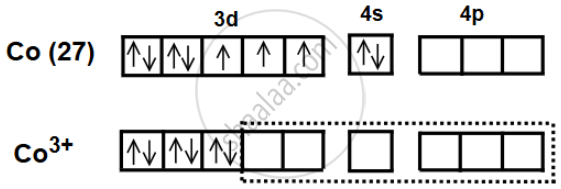
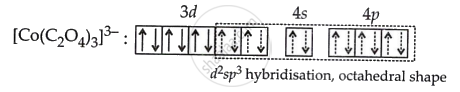
As there are 6 electrons, the hybridisation has to be sp3d2, forming an octahedral, inner orbital complex as per valence bond theory. Hence, it is clear that [Co(C2O4)3]3− is a diamagnetic and octahedral complex.
APPEARS IN
RELATED QUESTIONS
[NiCl4]2− is paramagnetic, while [Ni(CO)4] is diamagnetic, though both are tetrahedral. Why? (Atomic number of Ni = 28)
Explain on the basis of valence bond theory that [Ni(CN)4]2− ion with square planar structure is diamagnetic and the [NiCl4]2− ion with tetrahedral geometry is paramagnetic.
[Cr(NH3)6]3+ is paramagnetic while [Ni(CN)4]2− is diamagnetic. Explain why?
Discuss the nature of bonding in the following coordination entity on the basis of valence bond theory:
[CoF6]3−
Write the hybridisation and number of unpaired electrons in the complex `[CoF_6]^(3-)`. (Atomic No. of Co = 27)
[NiCl4]2- is paramagnetic while [Ni(CO)4] is diamagnetic though both are tetrahedral. Why? (Atomic no. Ni = 28)
Using valence bond theory, explain the following in relation to the complexes given below:
\[\ce{[Cr(H2O)6]^{3+}}\]
(i) Type of hybridisation.
(ii) Inner or outer orbital complex.
(iii) Magnetic behaviour.
(iv) Spin only magnetic moment value.
Write the hybridization and shape of the following complexes:
[Ni(CN)4]2−
In a coordination entity, the electronic configuration of the central metal ion is t2g3 eg1
Is the coordination compound a high spin or low spin complex?
As the s-character of hybridised orbital increases, the bond angle
What is the no. of possible isomers for the octahedral complex [Co(NH3)2(C2O4)2]?
In Fe(CO)5, the Fe – C bond possesses
Using Valence bond theory, explain the following in relation to the paramagnetic complex [Mn(CN)6]3−
- type of hybridization
- magnetic moment value
- type of complex – inner, outer orbital complex
According to the valence bond theory, the hybridization of central metal atom is dsp2 for which one of the following compounds?
[Ni(CO)4] has tetrahedral geometry while [Ni(CN)4]2− has square planar, yet both exhibit diamagnetism. Explain.
[Atomic number: Ni = 28]
During chemistry class, a teacher wrote \[\ce{[Ni(CN)4]^2-}\] as a coordination complex ion on the board. The students were asked to find out the magnetic behaviour and shape of the complex. Pari, a student, wrote the answer paramagnetic and tetrahedral whereas another student Suhail wrote diamagnetic and square planer.
Evaluate Pari’s and Suhail’s responses.
The geometry and magnetic behaviour of the complex [Ni(CO)4] are ______.
Which of the following are paramagnetic?
- [NiCl4]2−
- Ni(CO)4
- [Ni(CN)4]2−
- [Ni(H2O)6]2+
- Ni(PPh3)4
Choose the correct answer from the options given below:
