Advertisements
Advertisements
Question
Discuss the conservation of momentum in each of the following cases :
(i) a rocket taking off from ground.
(ii) flying of a jet aeroplane.
Advertisements
Solution
(i) A rocket taking off from ground
Answer: In rocket, a large volume of gases produced by the combustion of fuel is allowed to escape through it in the backward direction. Due to the very high velocity, the backward rushing gases have a large momentum. They impart an equal and opposite momentum to the rocket due to which the rocket moves forward with a great speed.
(ii) Jet aeroplanes utilize the principle of action and reaction. In modern jet aircrafts, the hot gases obtained by the rapid burning of fuel rush out of a jet at the rear end of the aircraft at a great speed. The equal and opposite momentum of the gases heading backwards pushes the aircraft forward at a great speed.
APPEARS IN
RELATED QUESTIONS
A shell of mass 0.020 kg is fired by a gun of mass 100 kg. If the muzzle speed of the shell is 80 m s–1, what is the recoil speed of the gun?
Define momentum of a body. On what factors does the momentum of a body depend ?
The velocity of a body of mass 10 kg increases from 4 m/s to 8 m/s when a force acts on it for 2 s.
(a) What is the momentum before the force acts ?
(b) What is the momentum after the force acts ?
(c) What is the gain in momentum per second ?
(d) What is the value of the force ?
A gun of mass 3 kg fires a bullet of mass 30 g. The bullet takes 0.003 s to move through the barrel of the gun and acquires a velocity of 100 m/s. Calculate:
- the velocity with which the gin recoils.
- the force exerted on gunman due to recoil of the gun
Explain why, a cricket player moves his hands backwards while catching a fast cricket ball.
A 150 g ball, travelling at 30 m/s, strikes the palm of a player’s hand and is stopped in 0.05 second. Find the force exerted by the ball on the hand.
State the law of conservation of momentum.
Why are car seat-belts designed to stretch some what in a collision ?
The troops (soldiers) equipped to be dropped by parachutes from an aircraft are called paratroopers. Why do paratroopers roll on landing ?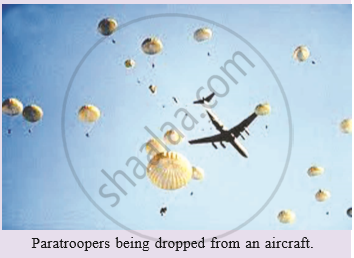
A heavy car A of mass 2000 kg travelling at 10 m/s has a head-on collision with a sports car B of mass 500 kg. If both cars stop dead on colliding, what was the velocity of car B ?
