Advertisements
Advertisements
Question
Differentiate between spermatogenesis and spermiogenesis.
Advertisements
Solution
| Sr. No. | Feature | Spermatogenesis | Spermiogenesis |
| 1. | Definition | It is the complete process of the formation of mature male gametes (spermatozoa) from diploid spermatogonia. | It is the final stage of spermatogenesis, where non-motile spermatids are transformed into motile spermatozoa. |
| 2. | Nature of Process | This process involves both mitotic and meiotic cell divisions to increase the cell count. | This process involves no cell division; it is only a structural metamorphosis or differentiation of cells. |
| 3. | Outcome | It starts with a single diploid cell and results in the formation of four haploid spermatids. | It results in the conversion of a round, heavy spermatid into an elongated, light, and functional sperm. |
| 4. | Key Changes | It involves stages of multiplication, growth, and maturation to form various intermediate cell types. | It involves specific changes like acrosome formation, nucleus condensation, and the development of a tail. |
RELATED QUESTIONS
With the help of a neat, labelled diagram describe the human male reproductive system.
Write the location and functions of the following in human testes :
Leydig cells
Humans reproduce ______.
Sketch the labelled diagram.
Human male reproductive system.
Give the names.
Hormones related with the male reproductive system.
Draw a label diagram.
Draw a labeled diagram to show the interrelationship of four accessory ducts in a human male reproductive system.
Explain the term Scrotum.
Mention, if the following statement is True or False. If false rewrite the wrong statement in its correct form:
Cowper’s gland opens into the urethra.
Draw a neat and labelled diagram.
Human male reproductive organs
Name the secondary sex organs in males.
The given diagram represents T. S of
lf vasectomized man attempts to rape, then the presence of which of the following confirms it?
Increased secretion of which hormone start the process of sperm formation at the time of puberty?
Seminal vesicles are located in ______.
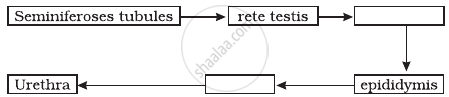
The path of sperm transport is given below. Provide the missing steps in blank boxes.
What are the components of semen?
In humans, sperm production occurs in the organ ______.
What is the whitish, viscous fluid secreted by glands along with spermatozoa called?
