Advertisements
Advertisements
Question
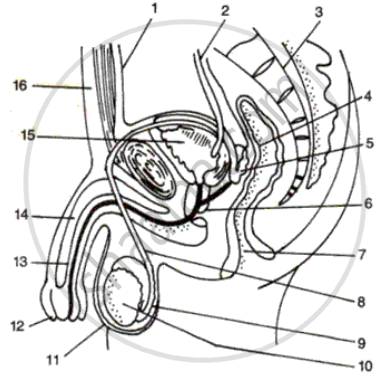
Given on the right is a diagram which represents the reproductive organs of a man:
(i) Write the names of the parts numbered 1 to 16.
(ii) Give two functions of the part 6.
(iii) Name three components of the fluid which may be found in the tube labeled 2.
(iv) What is the main function of the part labelled 3?
Advertisements
Solution
(i) 1. Peritoneum
2. Ureter
3. Backbone
4. Rectum
5. Seminal vesicle
6. Glands
7. Anus
8. Vas deferens
9. Epididymis
10. Left testis
11. Scrotum
12. Penis
13. Urethra
14. Vascular erectile tissue
15. Bladder
16. Muscular wall of abdomen
(ii) The two functions of part 6 are :
(a) Prostate gland secretes an alkaline milky secretion into semen that aids in sperm motility.
(b) Cowper's gland also secretes a lubricant.
(iii) The three components of urine are urea, uric acid, amino acids, glucose, sodium, potassium, vitamins etc.
(iv) The main function of the part labelled 3 is backbone. Its function is to give support, movement and protection to the spinal cord.
RELATED QUESTIONS
Write the answers to the questions by observing the figure.
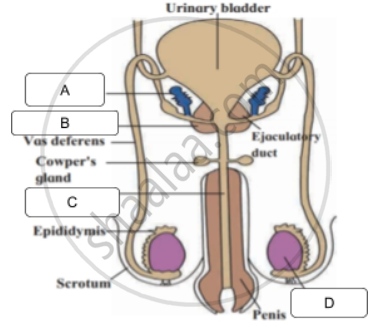
- What does the above figure show?
- Write the names of parts A, B, C, D.
- Write the function of the part 'D'.
- How is semen formed?
The ______ lead to vas deferens that ascends to the ______ and loops over the ______.
Vasa efferentia are the ductules leading from ______.
Seminal plasma, the fluid part of semen is formed by ______.
Temperature of the scrotum which is necessary for the functioning of testis is always ______ around below body temperature.
Which of the following provides a proof for forensic test in case of rape?
Given below is a certain situation. Analyze and describe its possible impact on a person:
Prostate and seminal vesicles are not functional.
Describe the function of Bulbourethral glands.
What is the length of the epididymis when uncoiled?
What is formed by the junction of the vas deferens and the seminal vesicle duct?
