Advertisements
Advertisements
प्रश्न
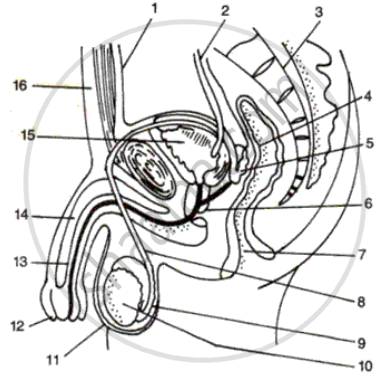
Given on the right is a diagram which represents the reproductive organs of a man:
(i) Write the names of the parts numbered 1 to 16.
(ii) Give two functions of the part 6.
(iii) Name three components of the fluid which may be found in the tube labeled 2.
(iv) What is the main function of the part labelled 3?
Advertisements
उत्तर
(i) 1. Peritoneum
2. Ureter
3. Backbone
4. Rectum
5. Seminal vesicle
6. Glands
7. Anus
8. Vas deferens
9. Epididymis
10. Left testis
11. Scrotum
12. Penis
13. Urethra
14. Vascular erectile tissue
15. Bladder
16. Muscular wall of abdomen
(ii) The two functions of part 6 are :
(a) Prostate gland secretes an alkaline milky secretion into semen that aids in sperm motility.
(b) Cowper's gland also secretes a lubricant.
(iii) The three components of urine are urea, uric acid, amino acids, glucose, sodium, potassium, vitamins etc.
(iv) The main function of the part labelled 3 is backbone. Its function is to give support, movement and protection to the spinal cord.
संबंधित प्रश्न
Why are the human testes located outside the abdominal cavity? Name the pouch in which they are present.
Draw a label diagram.
Draw a labeled diagram to show the interrelationship of four accessory ducts in a human male reproductive system.
Explain the term Gametogenesis.
Explain the term Scrotum.
Which of the following is a secondary sexual character observed in males?
In the process of spermatogenesis, first maturation division is called ______.
Occurrence of Leydig’s cells and their secretion is ______.
State very briefly the chief function of the following:
Cowper's gland
Given below is the outline of the male reproductive system. Name the parts labelled 1 to 8. Also name the corresponding structure of part (4) in female reproductive system.
 |
What is the enlarged tip of the penis called?
