Advertisements
Advertisements
प्रश्न
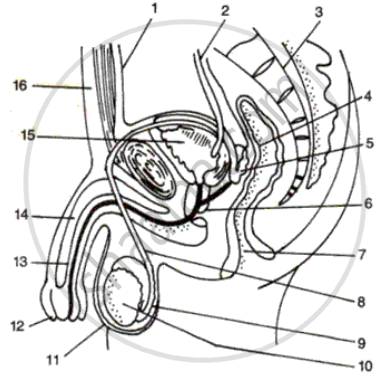
Given on the right is a diagram which represents the reproductive organs of a man:
(i) Write the names of the parts numbered 1 to 16.
(ii) Give two functions of the part 6.
(iii) Name three components of the fluid which may be found in the tube labeled 2.
(iv) What is the main function of the part labelled 3?
Advertisements
उत्तर
(i) 1. Peritoneum
2. Ureter
3. Backbone
4. Rectum
5. Seminal vesicle
6. Glands
7. Anus
8. Vas deferens
9. Epididymis
10. Left testis
11. Scrotum
12. Penis
13. Urethra
14. Vascular erectile tissue
15. Bladder
16. Muscular wall of abdomen
(ii) The two functions of part 6 are :
(a) Prostate gland secretes an alkaline milky secretion into semen that aids in sperm motility.
(b) Cowper's gland also secretes a lubricant.
(iii) The three components of urine are urea, uric acid, amino acids, glucose, sodium, potassium, vitamins etc.
(iv) The main function of the part labelled 3 is backbone. Its function is to give support, movement and protection to the spinal cord.
संबंधित प्रश्न
With the help of a neat, labelled diagram describe the human male reproductive system.
The external layer of connective tissue sheath of human testis is __________.
In humans, sperm production occurs in the organ ______.
The given diagram represents T. S of
Identify the location of Leydig cells.
Failure of testes to descend from abdomen into scrotum leads to ______.
Which of the following is a transporting tube leading from the bladder to which brings urine outside the body via penis?
Seminal plasma, the fluid part of semen, is contributed by.
- Seminal vesicle
- Prostate
- Urethra
- Bulbourethral gland
Which one of the following is not a male accessory gland?
Describe the function of Bulbourethral glands.
